Picture the first round of a partner self-assessment. The forms come back and they look wonderful: almost every partner rates its financial management "good" or "very good", and safeguarding is "fully in place" nearly everywhere. Then, on a routine call, a program officer asks one follow-up question: if someone reported abuse by a member of your staff tomorrow, where would the report go? The silence that follows tells you more than the whole form.
The partners did not lie. The questions invited those answers. An organizational self-assessment tool that asks for adjectives, seems to decide the next grant and is filled in by one person in an evening will produce a flattering picture almost every time. Below: why self-assessments inflate, seven rules for questions partners answer honestly, before-and-after rewrites, and a free three-page questionnaire with a filled-in example.
Why self-assessments come back too good
Three forces push the answers up, and none of them is bad faith.
- Wanting to look good. Survey researchers call it social desirability bias: people want to be accepted and liked, so they may overstate what is admired, such as their charitable contributions [1]. Out of concern for how they come across, respondents overreport what is socially desirable and underreport what is not [2]. A partner describing itself to a funder feels the same pull.
- Fear of consequences. A review of surveys on sensitive topics concluded that misreporting is common and largely situational, and that respondents edit what they report to avoid embarrassment or "to avoid repercussions from third parties" [3]. For a partner, the third party is the funder and the repercussion is the next grant. If the form might decide funding, a careful organization rates itself high. That is not dishonesty; it is prudence.
- Vague questions. "Is your board effective?" has no observable answer, so it gets the hopeful one. Pew Research Center's guidance on survey questions also warns about questions that ask about two things at once, and about agree-disagree statements, which some respondents tend to agree with [1].
The useful news is in the same research. How much people misreport depends on the design of the survey and the situation in which they answer [3], and survey designers can get more valid data by choosing methods that make a sensitive question less uncomfortable to answer [2]. You cannot change human nature. You can change the questions, and the conditions around them.
Seven rules for a partner self-assessment questionnaire
1. Ask what happens, not what people think
"Do you have strong financial controls?" asks for an opinion. "Who approves a payment before it is made?" asks for a fact, and a fact is much harder to inflate. Ask about behavior in a fixed period ("in the last 12 months"), about counts ("how many of your projects...") and about the evidence that would show it. Pew advises clear, specific questions in simple, concrete language [1]. In a self-assessment, concrete means something a visitor could see.
2. One thing per question
"Do you have a safeguarding policy and a focal point?" is two questions. A partner with a policy and no focal point cannot answer it truthfully, so it picks "yes". Pew calls these double-barreled questions and recommends asking two separate ones [1]. Every "and" in a question deserves a second look.
3. Describe every answer in something you can see
A scale from 1 to 5 with no descriptions lets each partner decide what a 4 means, and most will decide generously. Write a short, observable description for every option instead: "no approved budget yet", "budget checked once or twice a year", "every month", "every month, with the differences explained to the board". The capacity assessment grid McKinsey developed for Venture Philanthropy Partners (VPP) in 2001 worked this way: assessors score each element by choosing the text that best describes the organization today [4]. Keep to four or five options, as Pew suggests, because people struggle to keep more in mind at once [1]. Designing the levels themselves is covered in how to build a maturity model.
4. Make "not yet" a respected answer
The first option should be one a partner can choose without losing face. "Not yet" says this is a stage, not a verdict. Pew's question about past voting shows the technique: it first allows that something may have kept the respondent from voting, then asks whether they voted, and the guidance notes that the choice of response options can "make it easier for people to be honest" [1]. Also offer "don't know". The VPP grid lets assessors mark a row "N/K" when they have no knowledge of it [4], and in a partner organization "nobody here knows who keeps the hiring files" is a finding in itself.
5. Keep it apart from funding decisions
If the answers can cost a grant, you are not running a self-assessment. You are running an application, and partners will answer accordingly [3]. Say in writing, on page 1, what the results are for and what they will not be used for. Use due diligence for risk and funding decisions and keep the two exercises apart, as the guide to running a partner capacity assessment explains. Then keep the promise. The first time a "not yet" turns into a funding cut, every answer in every future round moves up a level.
6. A team answers, not the director alone
A director filling in the form alone reports the organization as the director sees it, and often as they hope it is. Ask for a small team: the people who do the work in finance, programs and HR, and a board member if possible. Disagreement inside that team is information. Drawing out different views is one of the stated purposes of the VPP grid, which calls different answers from staff, board members and funders "a valuable discussion-starter" [4].
7. Close the loop
Partners answer more honestly the second time when something useful came back the first time: a summary of their own answers, agreed priorities, real support. Also ask about the questionnaire itself: which question was unclear, and which one was hard to answer honestly? Peace Direct's 2021 report on decolonising aid goes further: it recommends that donors invite grantees to critique the donor's own power and practices, starting with an anonymous survey, and observes that if a conversation about power is not uncomfortable, "it is unlikely that open or honest opinions are being shared" [5].
Before and after: rewriting the usual questions
These seven questions, or close cousins of them, turn up in many partner questionnaires. Each rewrite asks about something that happened, has an answer a visitor could check, and cannot be answered with a hope.
| Before | What goes wrong | After |
|---|---|---|
| Does your organization have strong financial management? | An adjective nobody can check. Every partner can say yes. | Who approves a payment before it is made? |
| Do you have a safeguarding policy and a focal point? | Two questions in one. A partner with only one of them still answers yes. | If someone reported abuse by a staff member today, where would the report go? |
| Rate your MEAL capacity from 1 to 5. | A number with no description: a 4 means whatever the partner hopes. | How many of your main indicators have a baseline value? |
| We involve communities in our programs. (Agree / Disagree) | An agree-disagree statement invites agreement. | In your last project, how did the people you serve take part in its design? |
| Is your board effective? | A judgment, often made by someone who reports to that board. | In the last 12 months, how many board meetings had written minutes? |
| Do you plan to strengthen your HR systems? | Measures intentions. Every organization plans to. | When you hire, which checks do you make before the contract is signed? |
| Is your funding sustainable? | Vague, and it sounds like a test the partner could fail. | What share of last year's income came from your largest funder? |
The organizational self-assessment questionnaire (free template)
The template has three A4 pages. Page 1 is written for the partner: who should answer, how to choose, the four answers (Not yet, Starting, In place, Embedded) and what the program team promises in return, signed and dated. Pages 2 and 3 hold 18 questions in six domains, from governance to partnerships, each option described and each question with the evidence that would show it. The last section asks which question was hard to answer honestly.
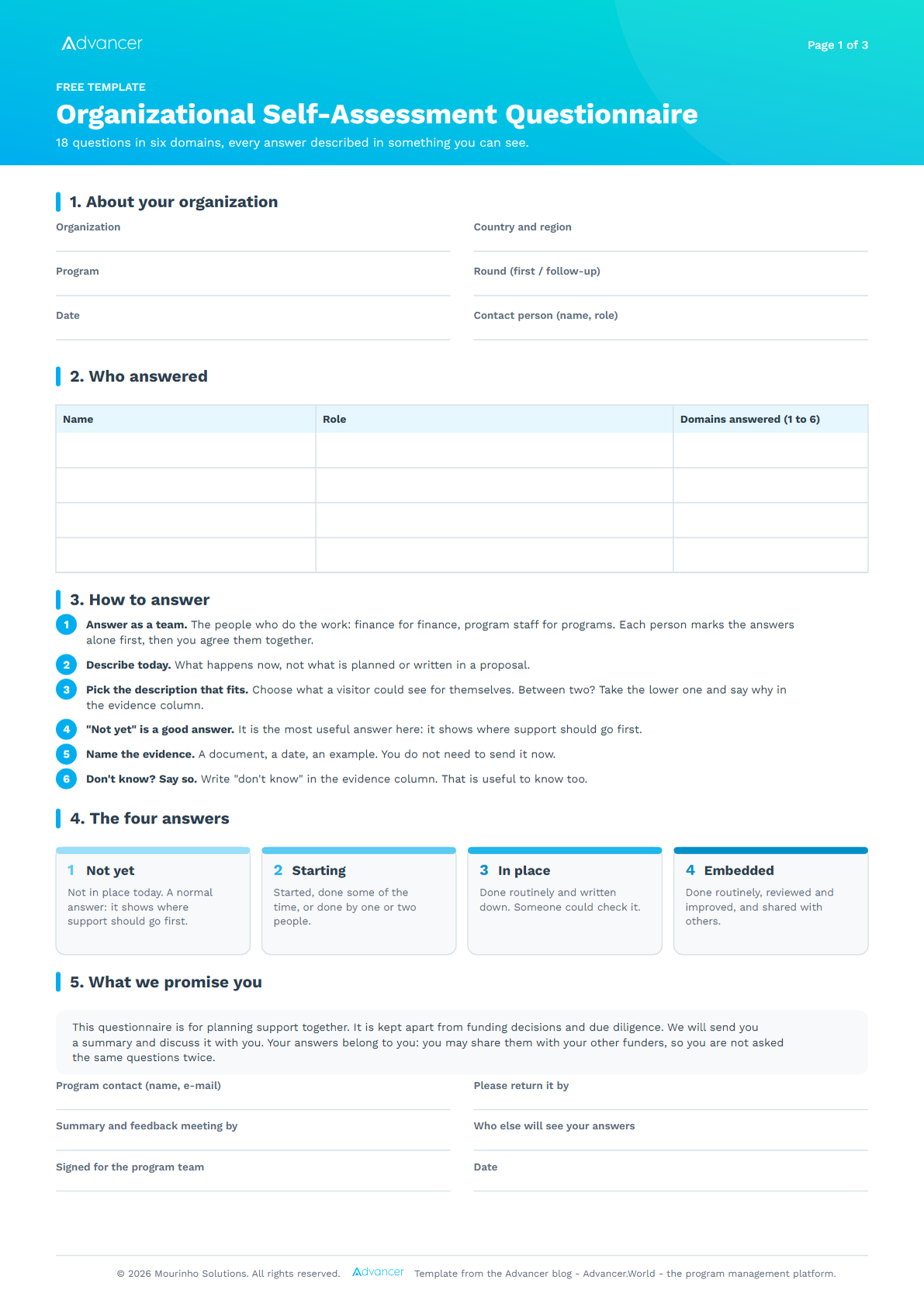
Download the organizational self-assessment questionnaire (PDF, 3 pages). Adapt the questions to your partners' context, then keep the wording identical from one round to the next: Pew notes that even small wording differences can change answers substantially, and recommends identical wording when results are compared with earlier surveys [1].
Running self-assessments with many partners? In Advancer.World each domain of the questionnaire becomes a row of one grid with the four answers as its stages. Partners place themselves, upload the evidence and see what the next level asks, and your team sees where each partner stands, round after round. Free to start.
Example: honest answers from a fictional partner
Here is the questionnaire filled in by Lakeside Youth Network, a fictional youth organization in Homa Bay County, Kenya, in its first round. Four people answered: the program coordinator, the finance officer, the safeguarding focal point and a board member.
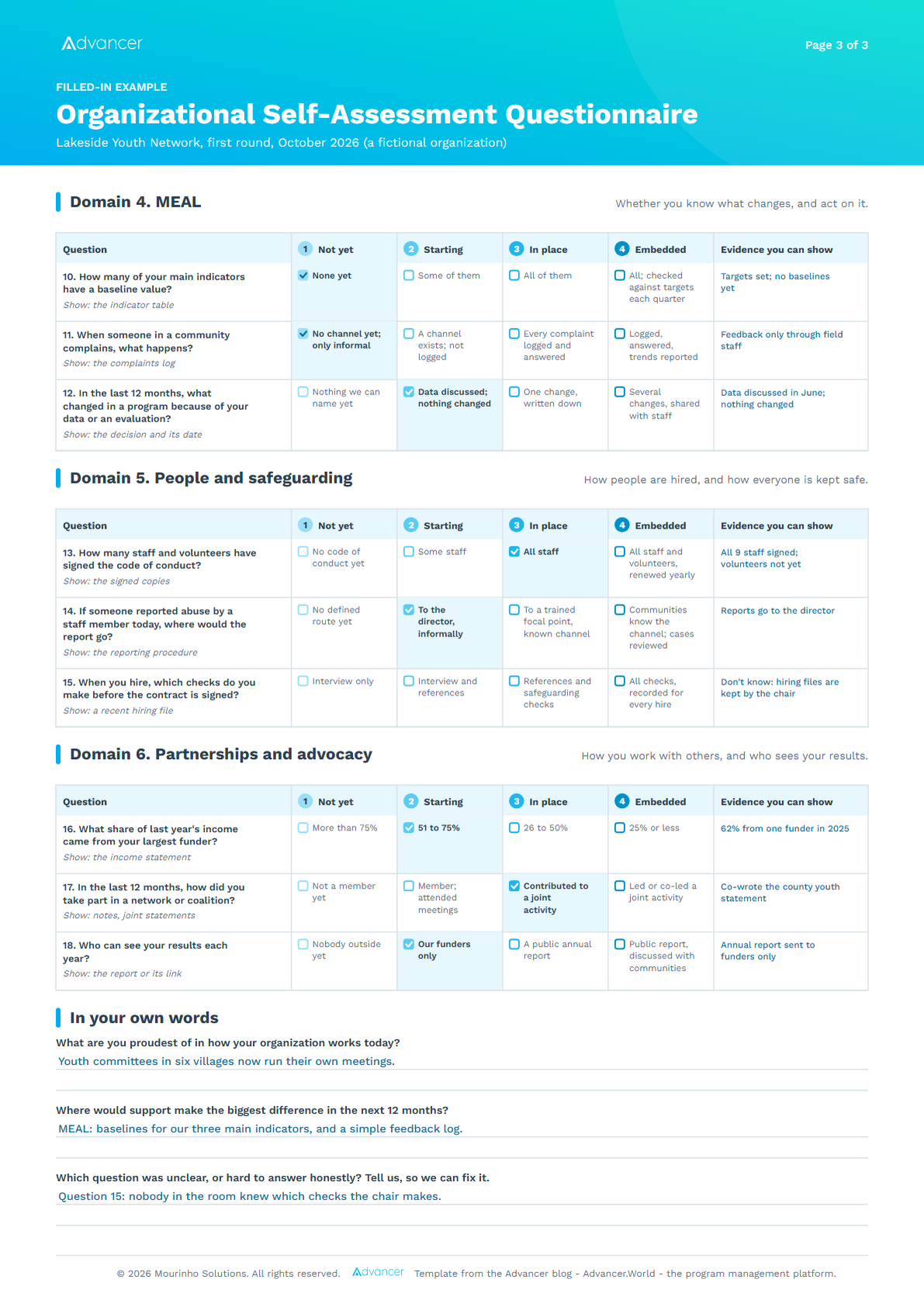
Download the filled-in example (PDF, 3 pages). Three things make it useful:
- "Not yet" appears, and it is specific. "Targets set; no baselines yet" tells the funder exactly where MEAL coaching would start.
- The evidence is a fact, not a claim. "Second signature above USD 300 only" explains a "Starting" on payment approval better than any comment.
- One question has no answer, on purpose. Nobody in the room knew which checks are made before someone is hired, because the hiring files are kept by the chair. That gap is worth more than a guessed "In place".
Running it so the answers stay honest
The questions do most of the work. The way you run the round does the rest:
- Send it with the promise signed. A promise with a date and a name on it is easier to believe.
- Private first, then together. Each person marks their answers alone, then the team meets to agree. Pew notes that social desirability bias can be greater when an interviewer is present than when people answer on their own [1], so the first, private answers are often the most candid.
- Look at the evidence as colleagues. A review conversation, not an inspection.
- Send the summary back within four weeks, with the priorities you agreed and the support behind each one.
- Repeat in 6 to 12 months with the same wording, starting from the last answers rather than a blank form.
What a good organizational self-assessment tool does
Paper works for a first round with a few partners. When thirty partners answer twice a year, the tool matters. Check that it:
- Keeps the wording stable across partners and rounds, so answers can be compared.
- Shows the described answers, not bare numbers, wherever a partner answers.
- Keeps the evidence next to the answer it supports.
- Shows each partner its own answers, and only its own. Honesty needs privacy.
- Remembers the last round, so the next one starts from it and change is visible.
- Works in the partner's language. Precise answers are hard to give in a third language.
Partner self-assessment in Advancer.World
Advancer.World, born from the digital transformation of programs at organizations such as UNICEF and Airbus, turns this kind of questionnaire into a program grid. The stages are the answers, the topics and subtopics are the domains, and each cell holds the observable description of that level. A program can run in self-assessment mode: the partner places itself on each row, and the steps between cells carry the questionnaires, the evidence uploads and the tasks that lead to the next level.
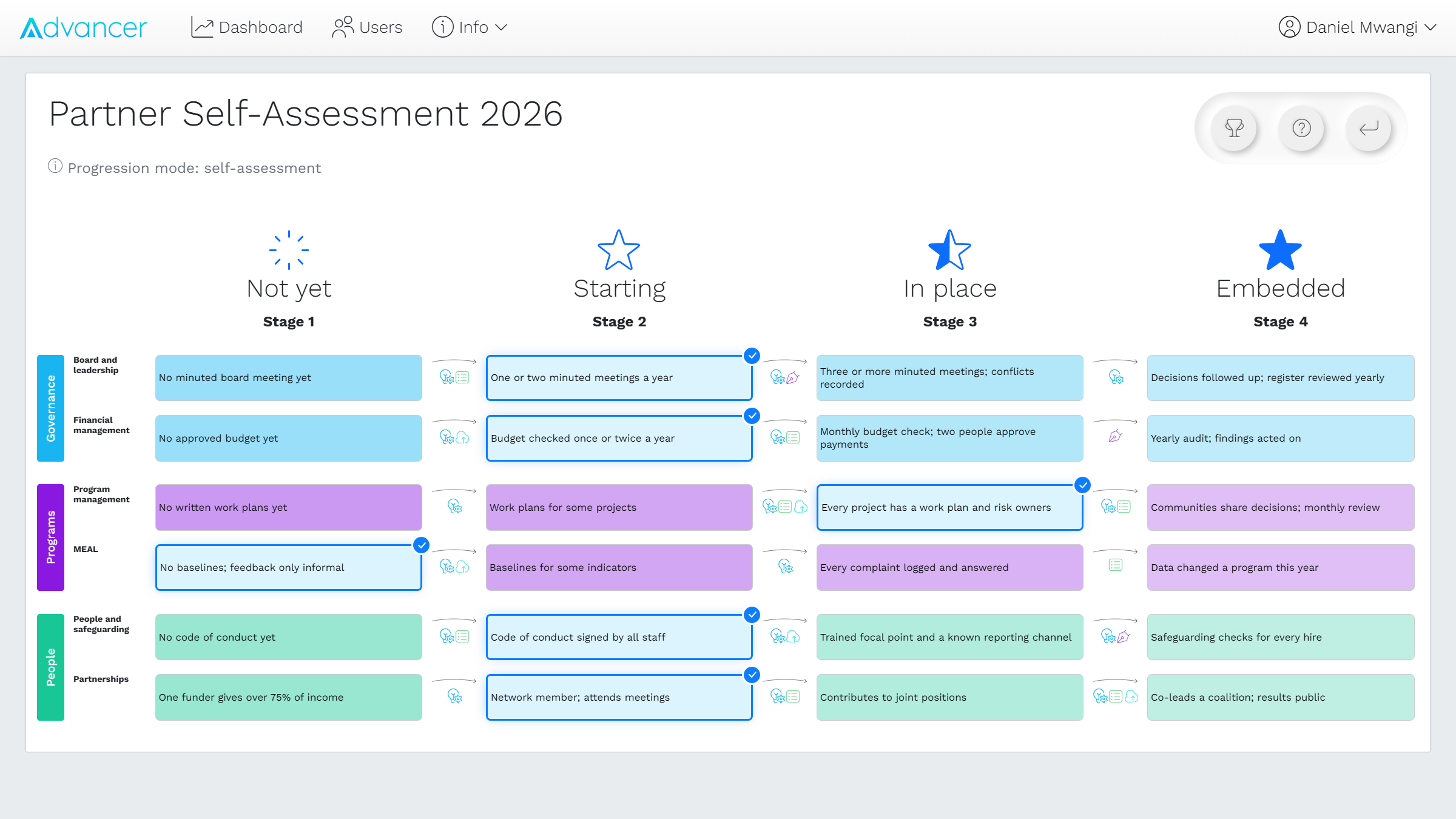
Partners sign in to see their own position and what the next stage asks, and they never see another partner's data. The platform works in 22 languages, including Arabic, Urdu, Swahili and Hausa. Daily snapshots keep the history, so the second round starts where the first ended. If your team prefers to confirm every move itself, the program can run in manual mode instead.
FAQ
Should the answers be anonymous?
Not at the level of the organization: you cannot support a partner whose answers you cannot see. Inside the partner's team, the private first answers described above do that job. Feedback about you as a funder is different: for that, Peace Direct suggests starting with an anonymous survey [5].
How many questions should a partner self-assessment questionnaire have?
As few as you need to decide. The template has 18, three per domain. Before adding one, ask what you would do differently depending on the answer. If nothing, leave it out.
What if a partner answers "not yet" to almost everything?
Then you have an honest baseline and a clear place to start. Agree two or three questions where support would make the biggest difference, and fund them. A partner that starts low and moves up tells a better story to your board than one that starts high and stays there.
Ask better, hear more
Partners usually know where they stand. Whether they tell you depends on what you ask, what you do with the answer, and whether "not yet" is safe to say. Rewrite five of your current questions with the table above, run them with one partner you trust, and send the summary back within four weeks. Then see what changes in the second round.
Give every partner the same honest questions, round after round. Design your self-assessment once in Advancer.World, invite your partners, and keep every position and its evidence for the next round. Free to start.
References
- Pew Research Center, "Writing Survey Questions", https://www.pewresearch.org/writing-survey-questions/ (accessed October 2026).
- Ivar Krumpal, "Determinants of social desirability bias in sensitive surveys: a literature review", Quality & Quantity 47(4), 2025-2047, 2013, https://link.springer.com/article/10.1007/s11135-011-9640-9 (accessed October 2026).
- Roger Tourangeau and Ting Yan, "Sensitive questions in surveys", Psychological Bulletin 133(5), 859-883, September 2007, https://pubmed.ncbi.nlm.nih.gov/17723033/ (accessed October 2026).
- McKinsey & Company for Venture Philanthropy Partners, "Effective Capacity Building in Nonprofit Organizations", 2001, https://www.bridgespan.org/getmedia/ef1ff943-173b-48ec-843a-b5ce85c6c807/effective-capacity-building-VPP.pdf (accessed October 2026).
- Peace Direct, Adeso, Alliance for Peacebuilding and Women of Color Advancing Peace and Security, "Time to Decolonise Aid: Insights and lessons from a global consultation", second edition, May 2021, https://www.peacedirect.org/publications/timetodecoloniseaid/ (accessed October 2026).
© 2026 Mourinho Solutions. All rights reserved.