Most partner capacity assessments I have seen run on a spreadsheet live the same short life. Someone designs it with care and sends it to twelve partners. It comes back as nine versions of the file, gets merged over a weekend, produces one colorful chart for a board meeting, and is never opened again. A year later a new spreadsheet starts from zero, and nobody can say whether the partners actually got stronger.
The questionnaire is rarely the problem. The method around it is: what you measure, how you rate it, what happens with the result, and whether you can repeat it next year and see the change. This guide gives you a partner capacity assessment you can use tomorrow, as a free template and a filled-in example, the method behind it, and what to look for in a partner capacity assessment tool once the spreadsheet stops scaling.
Why partner capacity assessment matters more now
In 2016, the donors and aid organizations that signed the Grand Bargain committed to increase multi-year investment in the institutional capacities of local and national responders, and to channel at least 25 percent of humanitarian funding to them "as directly as possible" by 2020 [1]. Funding local organizations directly raises an obvious question for the funder: how strong is this partner today, and what would make it stronger?
The same agreement also committed signatories to share partner assessment information, to save time and avoid duplication [1]. That second commitment gets less attention, and it matters just as much. A local organization working with several funders still often answers a different questionnaire for each of them, about the same board, the same accounts and the same safeguarding policy. Every repeated assessment is time taken away from the programs it is supposed to strengthen.
A good partner capacity assessment does three things a one-off questionnaire does not: it uses the same yardstick for every partner, it produces a plan rather than a score, and it can be repeated so that change becomes visible.
Capacity assessment is not due diligence
Before choosing a template, be clear about which question you are answering. Many organizations run two different exercises under one name.
- Due diligence and risk assessment answers "can we transfer money to this partner, and with which controls?" The United Nations' Harmonized Approach to Cash Transfers is a well-known example: its micro-assessment reviews an implementing partner's financial management and ends in a risk rating, low, moderate, significant or high, which decides how cash is transferred and how often it is checked [2].
- Capacity assessment answers "where does this partner stand, and what should we strengthen together next?" It covers more than finance, and its output is a plan.
Both are legitimate. Mixing them is what goes wrong. If a partner believes the capacity assessment can cost it a grant, it will rate itself high and hide exactly the gaps you need to see. Keep the two apart, say so in writing, and the quality of the answers changes.
The six domains of a partner capacity assessment
Capacity frameworks differ in names and grouping, but most cover the same ground. The template below uses six domains, with five indicators each:
| Domain | What it looks at | An indicator |
|---|---|---|
| Governance and leadership | Who decides, how, and who holds them to account | A conflict of interest policy exists and is applied |
| Financial management | Whether money is planned, recorded and controlled | Payments need two people: one prepares, another approves |
| Program management | How projects are planned, run and adjusted | Risks are identified and each one has an owner |
| MEAL | Monitoring, evaluation, accountability and learning | Communities can give feedback or complain, and get an answer |
| People and safeguarding | How staff are hired and supported, and how people are kept safe | A safeguarding policy, a focal point and a safe reporting channel |
| Partnerships and advocacy | How the organization works with others and shapes its context | More than one funder, and none above half of the income |
Treat the indicators as a starting point. A women's rights organization in a county capital and a national federation of farmers' unions should not be rated against identical wording. Agree the adjustments with the partners before anyone rates anything, and keep the domains and the scale stable, so results stay comparable across the portfolio.
A four-level scale, described in what you can see
The template rates every indicator on four levels: Emerging (little in place, it depends on one or two people), Developing (the basics exist on paper and are used some of the time), Established (written down, used routinely and checked) and Advanced (reviewed, improved and shared with others).
Four levels is a long-standing choice. The capacity assessment grid McKinsey developed for Venture Philanthropy Partners in 2001 also used four, from "clear need for increased capacity" to "high level of capacity in place" [3]. An even number has a practical advantage: there is no comfortable middle box to retreat to. And each level is described by something you can observe, a document, a practice, a meeting, never by an adjective like "good" or "strong".
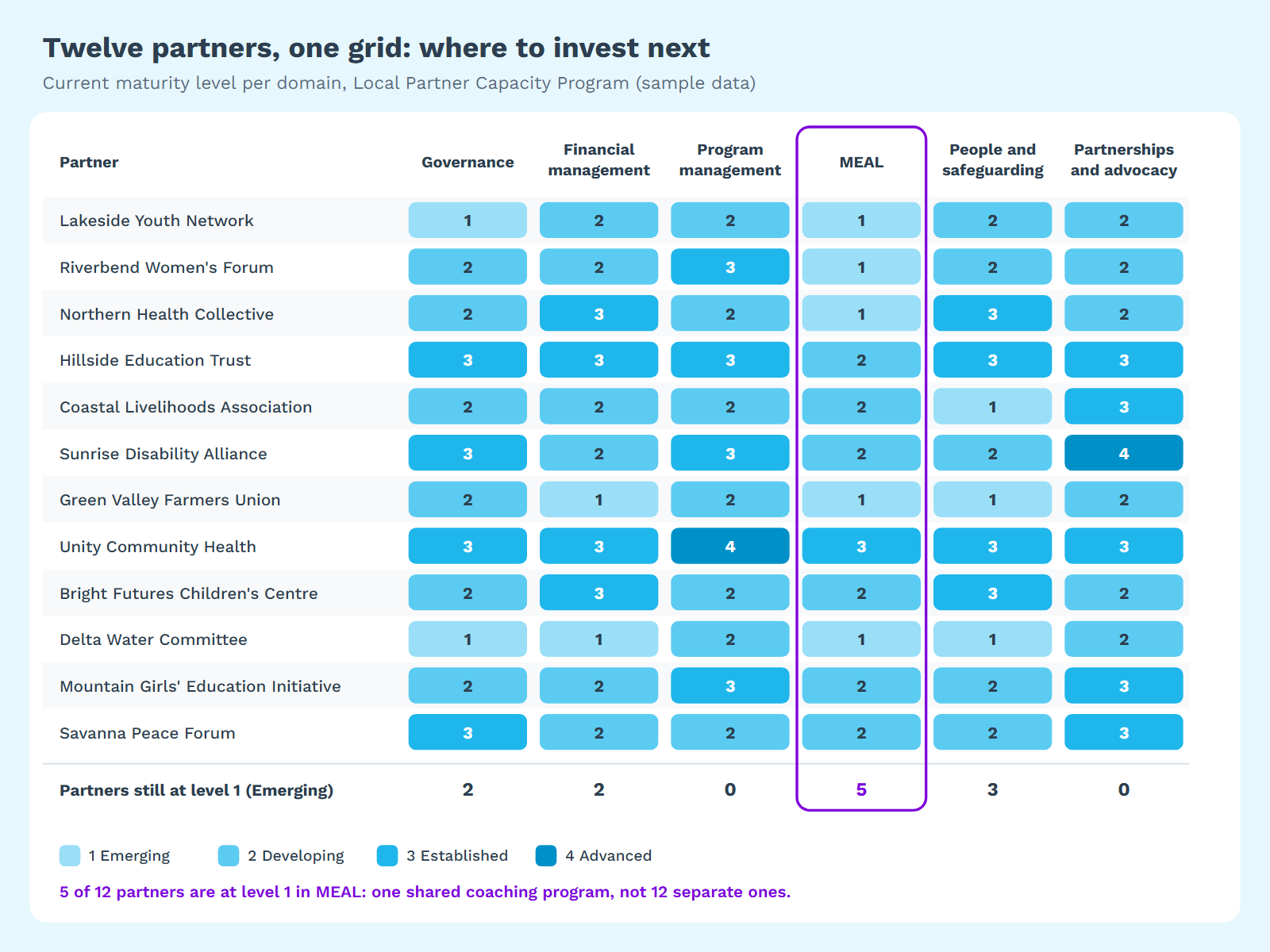
One warning from my training in operations research: maturity levels are ordinal. A 3 is above a 2, but it is not "one more" than a 2, and a partner with 2, 2, 2 is not in the same place as one with 1, 2, 3. So do not average levels across domains into a single score per partner. Look at the profile, and when you look at the portfolio, count: how many partners are still at level 1 in each domain. That count will tell you where to invest.
The partner capacity assessment template (free download)
The template has four A4 pages: the partner's details, how to use it and the scale (page 1), the six domains with their indicators, levels and evidence (pages 2 and 3), and the summary, the capacity strengthening plan and the sign-off (page 4).
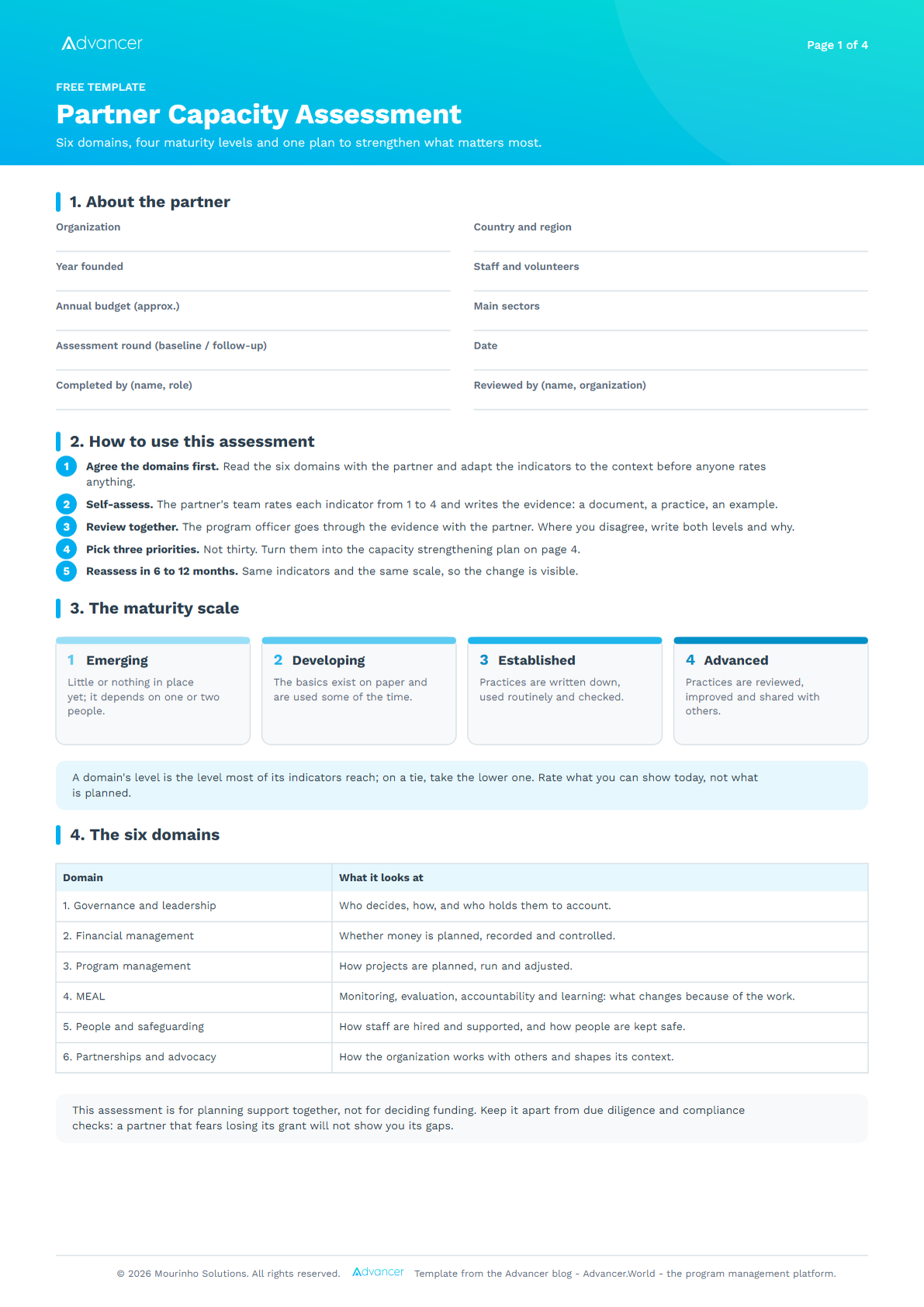
Download the partner capacity assessment template (PDF, 4 pages). Print it, or copy the domains and indicators into your own form.
Assessing more than a handful of partners? In Advancer.World the six domains and four levels become one grid that every partner works on: self-assessment, evidence, your review and the next steps in one place, with the history kept for the next round. Free to start.
Example: a filled-in partner capacity assessment
Here is the same template filled in for Riverbend Women's Forum, a fictional organization in Kisumu County, Kenya, at its baseline assessment in October 2026.
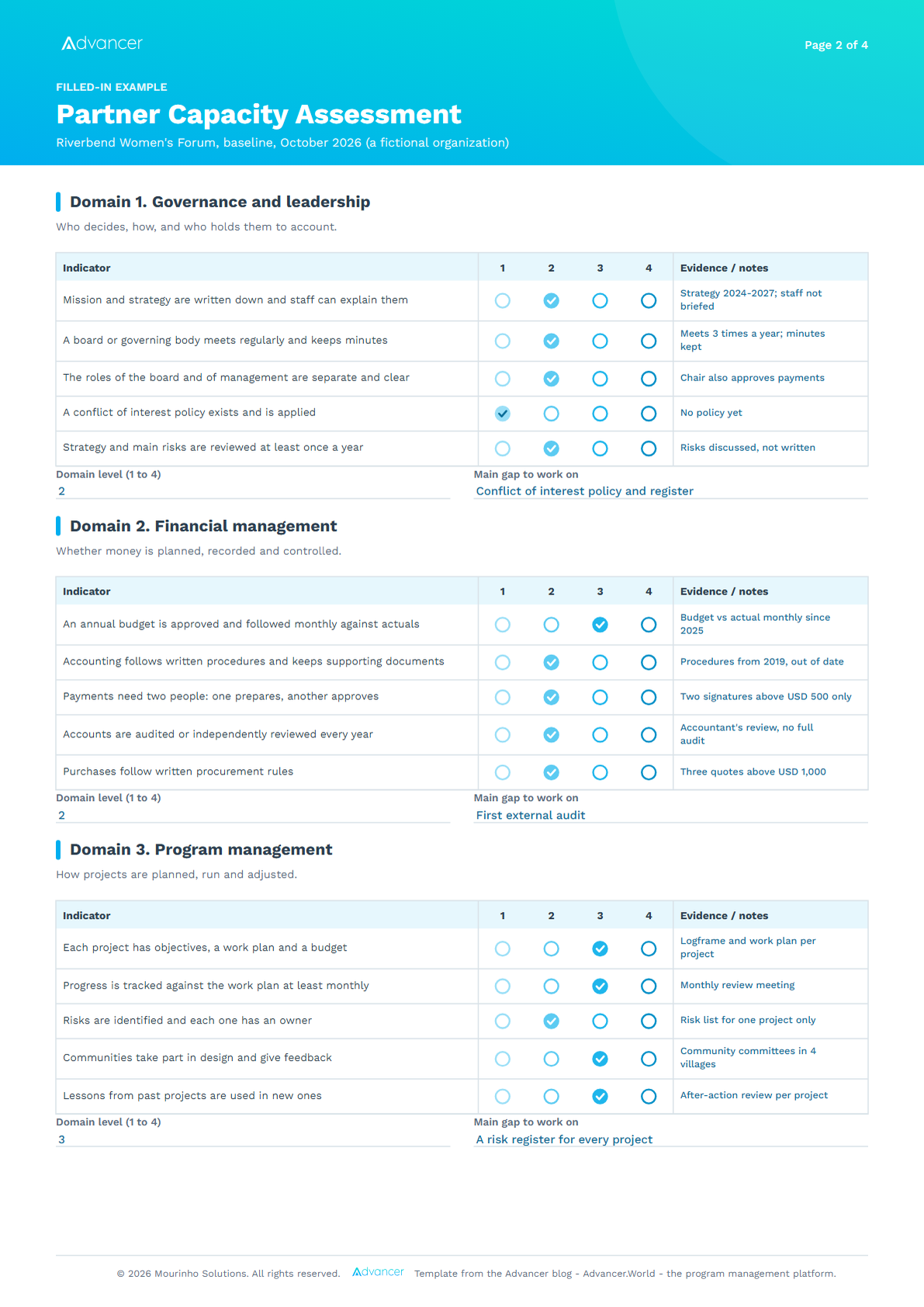
Download the filled-in example (PDF, 4 pages). Three choices make it useful:
- Every rating carries its evidence. "Two signatures above USD 500 only" explains a level 2 on payment controls better than any comment field.
- Disagreement stays visible. Riverbend rated its financial management at 3; after the review the agreed level is 2, because the accounts have never had a full external audit. Both numbers are on page 4. Hiding the self-assessed level would teach partners that their own view does not count.
- Three priorities, each with the support it needs. The audit, MEAL baselines and a safe reporting channel. Each has an owner, a date and what Riverbend needs from the funder, such as the audit fee in the next grant. An assessment that only lists gaps, with no budget to close them, is an extraction exercise.
How to run it, step by step
- Agree the domains and the indicators with the partners, in a one-hour kick-off. Explain what the assessment is for, and what it will not be used for.
- Self-assessment. The partner's team rates each indicator and writes the evidence. Give them a week; it takes two or three hours of their time, better spread over a few conversations than done by one person in an evening.
- The review conversation. Go through the evidence together, ideally in person, in about two hours. Where you disagree, write both levels and why.
- The plan. Pick three priorities, not thirty, and decide what support each one needs and who pays for it.
- Reassess in 6 to 12 months, with the same indicators and the same scale, starting from the previous result instead of a blank page.
Where the spreadsheet breaks
A spreadsheet is fine for one partner and tolerable for five. Beyond that, the same things fail every time:
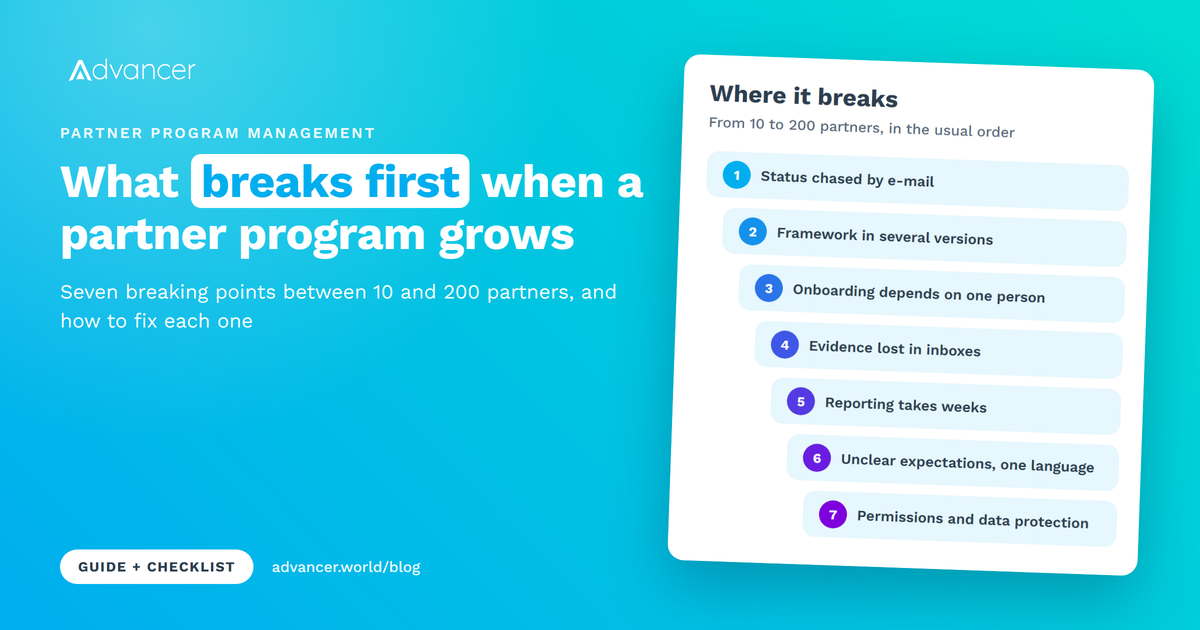
- Versions. Each partner edits its own copy, renames a column or adds a tab, and merging the files becomes a project in itself.
- Evidence lives elsewhere. The policy, the audit and the minutes sit in email attachments, disconnected from the rating they justify.
- No history. Next year's file overwrites this year's, so the one question that matters, did they get stronger, has no answer.
- The partner never sees its own trajectory. The results travel up to the funder and rarely come back in a form the partner can use.
- No portfolio view. Seeing all partners side by side means building it by hand, so it happens once a year, if at all.
The portfolio view is where a consistent assessment pays off. When every partner is rated against the same grid, the question "where do we invest next?" stops being a matter of opinion:
What to look for in a partner capacity assessment tool
Whether you build it yourself or buy it, a partner capacity assessment tool should cover these eight points:
- One framework, many partners. You design the domains, levels and indicators once, and every partner works on the same version.
- Self-assessment with evidence. Partners rate themselves and attach the document or describe the practice, in the same place.
- Your review. You can confirm a level or agree a different one, and both stay recorded.
- History. Every round is kept, and the next one starts from the last.
- A portfolio view. All partners side by side, by domain, without exporting and merging.
- Plans linked to the gaps. The next step for each partner is attached to the level it is working towards, with owners and dates.
- Partners see their own results. And can show them to other funders, which is the Grand Bargain's commitment to share assessment information, applied [1].
- Languages and data protection. Partners work in their own language, and access follows roles: a partner never sees another partner's data.
Running partner capacity assessments in Advancer.World
Advancer.World was born from the digital transformation of programs at organizations such as UNICEF and Airbus, and it is built around the structure this article describes. A program is a grid: the stages are the maturity levels (Emerging, Developing, Established, Advanced), the topics are the capacity domains, and each cell describes what that level looks like in that domain.
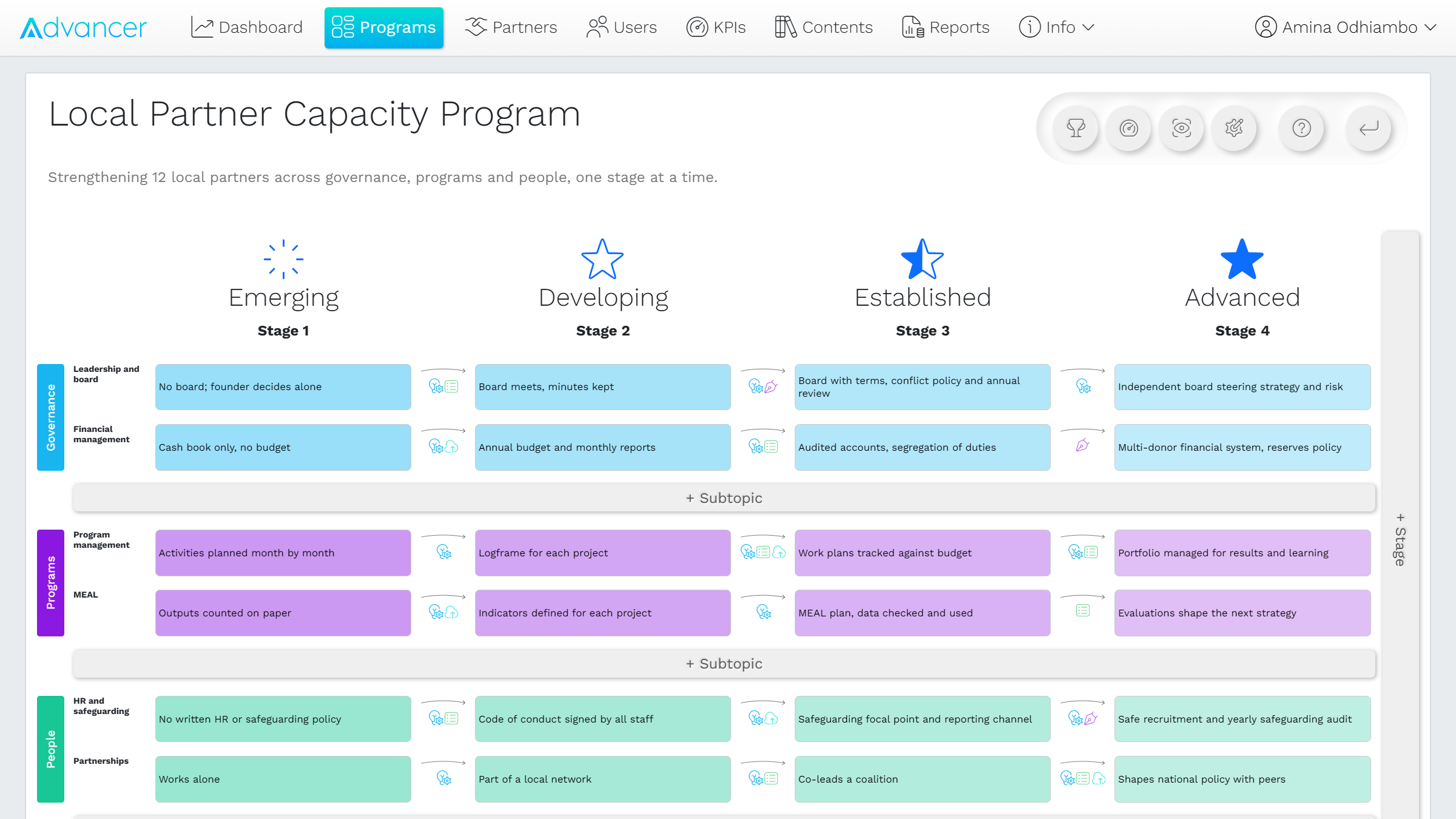
The steps between levels carry the work: initiatives, questionnaires, document uploads for the evidence, and signature requests. You choose how partners move forward: by self-assessment, automatically when the previous step is done, or only when your team confirms it. Partners sign in and see where they stand and what the next level asks of them, in any of the platform's 22 languages.
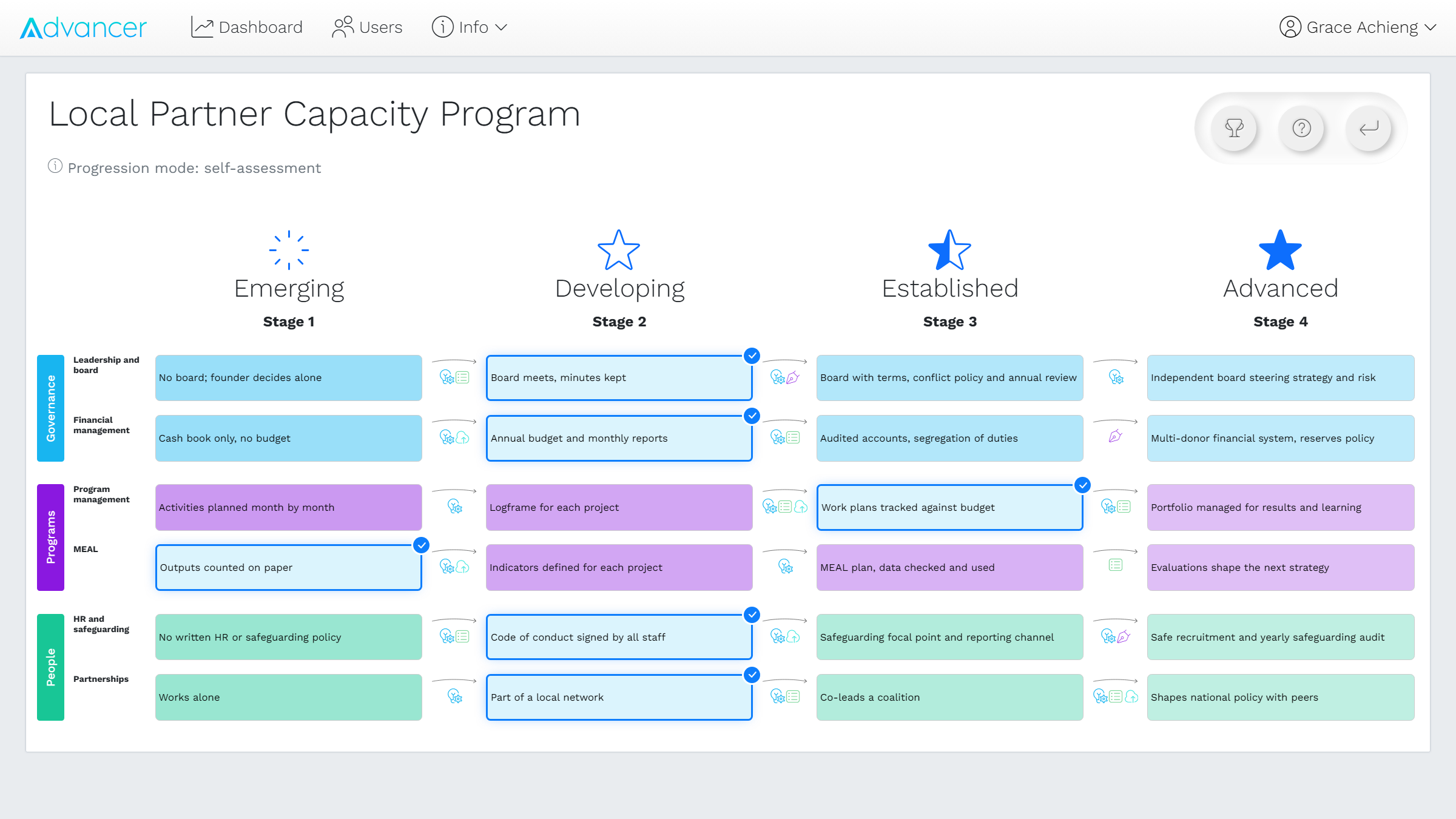
Every move is recorded, so the next round starts where the last one ended and the trend is already there when you report to your board or your donors.
Assess with partners, not of them
Capacity assessments have a reputation problem, and it is earned. In Peace Direct's 2021 global consultation on decolonising aid, the idea that local organizations "lack capacity" came up in almost every discussion thread, and participants named due diligence requirements that exclude local organizations among the practices to change [4]. A partner that has answered the same questions for five funders, and seen nothing come back, has every reason to be skeptical.
Four habits make the difference: design the indicators with partners, not for them; share every result with the partner that produced it; let partners reuse their results with other funders; and never assess without a budget for the plan. Assessment is the cheap part. Strengthening is the point.
FAQ
How often should we assess partner capacity?
Once at the start of a partnership as a baseline, then every 6 to 12 months. More often than that and partners spend their time reporting; less often and the plan loses its connection to reality.
Who should fill in the assessment?
The partner's own team, with the director and the people responsible for finance, programs and HR in the room. Then the funder's program officer reviews it with them. An assessment filled in by the funder alone tells you what the funder thinks, not what the partner knows.
Should the results decide funding?
Not directly. Use due diligence for funding and risk decisions, and the capacity assessment to decide what to strengthen. Tying the scores to grants is the fastest way to get inflated scores.
Can we change the domains and indicators?
Yes, and you should adapt the indicators to your sector and context. Keep the scale and the domains stable across partners and rounds, so the results remain comparable.
Is a partner capacity assessment the same as an organizational capacity assessment?
The method is the same. "Organizational capacity assessment" usually means an organization assessing itself; "partner capacity assessment" is the same exercise run across a funder's or network's partners, which is where consistency and a portfolio view start to matter.
Start with your next partner
You do not need a new system to start. Print the template, run it with one partner you trust, and see what the conversation gives you. When you have twelve partners and a second round coming, that is the moment to stop merging spreadsheets.
Run every partner on the same grid, round after round. Design your capacity program once, invite your partners, and see where every one of them stands. Free to start.
References
- "The Grand Bargain: A Shared Commitment to Better Serve People in Need", Istanbul, 23 May 2016, https://gblocalisation.ifrc.org/wp-content/uploads/2018/06/grand_bargain_final_22_may_final-2_0.pdf (accessed October 2026).
- United Nations Development Group, "Harmonized Approach to Cash Transfers (HACT) Framework", February 2014, https://unsdg.un.org/sites/default/files/HACT-2014-UNDG-Framework-EN.pdf (accessed October 2026).
- McKinsey & Company for Venture Philanthropy Partners, "Effective Capacity Building in Nonprofit Organizations", 2001, https://www.bridgespan.org/getmedia/ef1ff943-173b-48ec-843a-b5ce85c6c807/effective-capacity-building-VPP.pdf (accessed October 2026).
- Peace Direct, Adeso, Alliance for Peacebuilding and Women of Color Advancing Peace and Security, "Time to Decolonise Aid: Insights and lessons from a global consultation", second edition, May 2021, https://www.peacedirect.org/publications/timetodecoloniseaid/ (accessed October 2026).
© 2026 Mourinho Solutions. All rights reserved.