Partner maturity model builder
Build a maturity model for your partner network: stages across, topics down, and what each stage looks like in each cell. Start from a template for partner capacity, localization, safeguarding or digital maturity.
Building this for a network of partners? In Advancer.World each partner places itself on your model and you see where every partner stands. Try it free in Advancer.World
Sending this to partners by e-mail? In Advancer.World each partner fills it in online, in their own language, and you see every answer in one place. Start free
How to build a maturity model for your partners
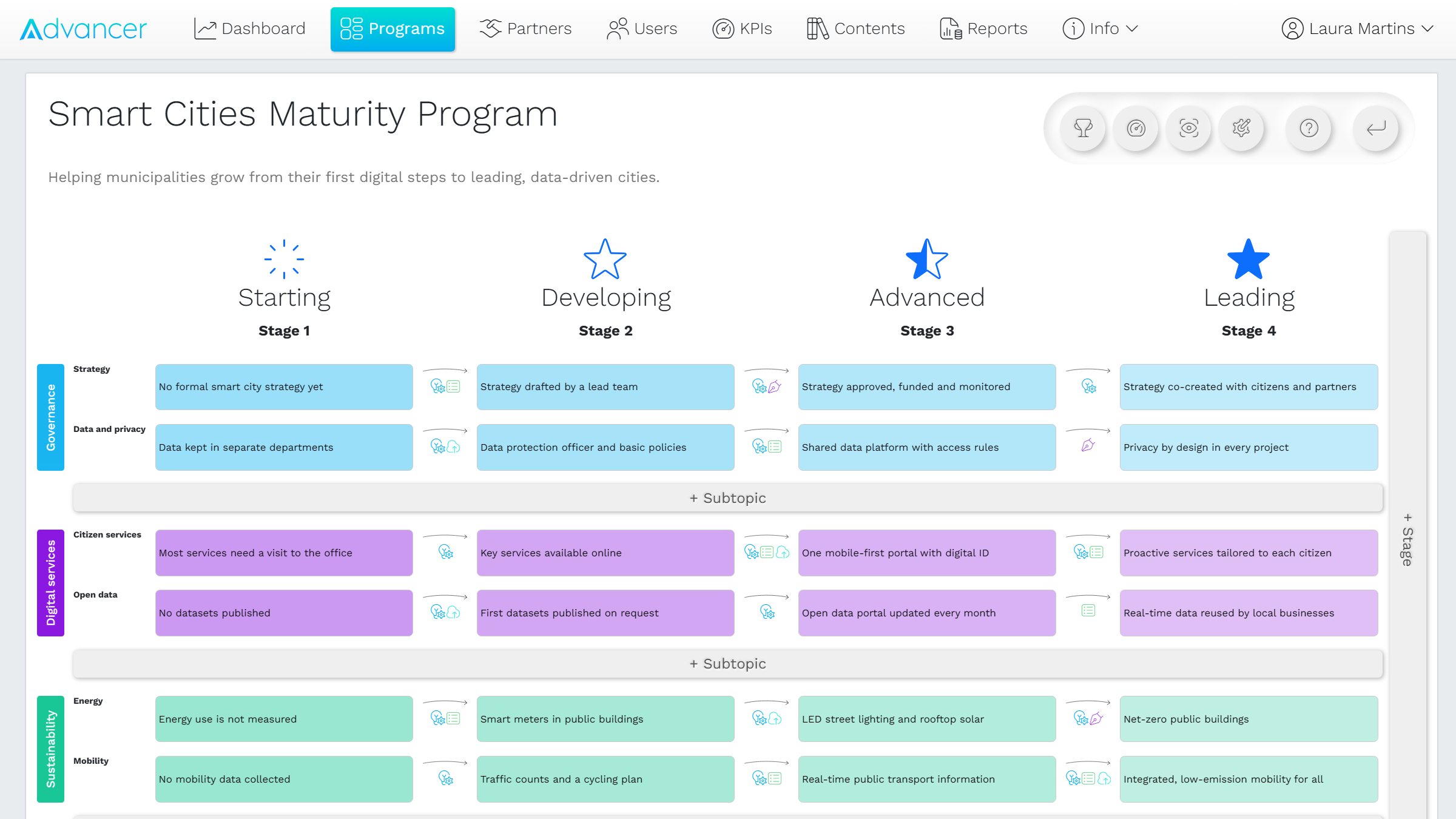
A maturity model describes the path you want partners to follow, in steps they can recognise. Choose four or five stages, from where most partners start to where you want the best ones to be, and name them in words partners would use about themselves.
Then pick the topics your program depends on - governance, finance, safeguarding, advocacy - and describe each stage of each topic as something you can observe: a policy exists, a report arrives on time, a budget line is there. Avoid words such as "good" or "strong": two people should place a partner in the same cell.
Test it with three partners before you roll it out: ask them to place themselves, then discuss the cells where you disagree. Those conversations are where the model improves, and where partners start to own it.
Put your model to work with every partner
In Advancer.World your stages and topics become a program grid. Partners place themselves on it, the work each step requires is attached to it, and you see the whole network on one screen.
- Every partner sees where it stands and what the next stage asks of it
- Tasks, surveys, documents and KPIs attached to each step
- Reports and snapshots of the whole network, in 22 languages
Free for up to 5 partners. No card needed.
What is a partner maturity model?
A grid that describes, topic by topic, what a partner looks like at each stage of development, from just starting to leading. It gives you and your partners a shared language for where each one stands and what the next step is.
How many stages should a maturity model have?
Four is the most common choice: enough to show progress, few enough that partners can tell the stages apart. This tool lets you use between two and seven.
Is my model saved?
It is kept in this browser only, on this device, so you can come back to it. Nothing is sent to our servers. Download it as Excel to keep a copy or to share it.
Can I use these templates in my organization?
Yes. The templates are free to use and to adapt. They are a starting point: change the stages and descriptions to fit your program and your partners.
More free tools for program teams
Ready to advance your world?
Create your account and have your first program running today.