During my years at UNICEF I met advocacy teams who knew their programs inside out, and who still needed days of work to answer the most basic partner progress assessment question: where is each partner right now? The answer lived in inboxes. An e-mail to every partner, a reminder, a phone call to the ones who did not reply, a spreadsheet updated by whoever had a free afternoon. If you have ever written a subject line ending in "(reminder 3)", you know the genre. By the time the table was complete, the first answers were already out of date, and the team had spent days chasing instead of advocating.
Nobody plans it that way. It is what happens when a program has more partners than the team has hours, and it does not have to work like that. There are three ways to know where your partners stand: let partners assess themselves, let the work they complete move them automatically, or have your team set each position after reviewing the evidence. Each one is right somewhere and wrong somewhere else. This article explains why the question matters for MEAL, what each way gives you and costs you, and how to choose, with a free two-page guide and a filled-in example from a child-friendly municipality program.
Why knowing where your partners stand matters for MEAL
The IFRC's monitoring and evaluation guide defines monitoring as "the routine collection and analysis of information to track progress against set plans" [1]. It adds that monitoring helps teams spot trends, adapt their strategies and make decisions. In a partner program, the plan is the path each partner follows: the stages from where it starts to where the program wants it to be. A partner's current position on that path is monitoring data, and probably the most important kind you have.
When positions are current, the rest of MEAL gets easier:
- Monitoring. You see who moved, who is stuck and who has gone quiet, while there is still time to help.
- Evaluation. Positions recorded over time are your baseline and your trend, not something to rebuild from old e-mails.
- Accountability. Your board and donors get a picture you can defend, and partners know where they stand.
- Learning. When most partners stall at the same stage, the problem is probably the stage, not the partners. You only see that pattern when every position is on one page.
The catch is the word routine. A position collected once a year by e-mail is not monitoring. It is history. The way you assess progress decides how routine it can be, and who pays for it in hours.
1. Self-assessment: partners place themselves
In the first way, the partner reads what each stage looks like on each theme and says, in effect, "this is where we are." Your team reviews the result instead of collecting it.
The virtues are real. Your team stops chasing and gets its time back for the work that needs it: coaching, advocacy, the partner who is struggling. The partner owns its position, and placing yourself is already a reflection on your own practice. Ryan and Deci's self-determination theory names three basic psychological needs, competence, autonomy and relatedness, and finds that people are more self-motivated when they are met [2]. Being trusted to judge your own progress speaks to the first two. Self-assessment works best with conscious, mature partners, and it helps the others become that.
Its limit is just as real. If you have ever filled in the skills section of a CV, you know it already. Zell and Krizan brought together 22 meta-analyses on whether people know how good they are: the mean correlation between how people rate their abilities and how they actually perform was .29, a moderate link [3]. Organizations are made of people, plus incentives: when funding follows the stage, some partners rate generously, and where modesty is a virtue, others rate themselves a stage too low.
So make self-assessment honest by design. Describe every stage with something you can see ("a children's council meets every quarter"), not an adjective ("strong participation"). Ask for evidence on the steps that matter. And talk positions through with each partner once a year: the conversation is worth more than the rating.
2. Automatic: the work moves the partner
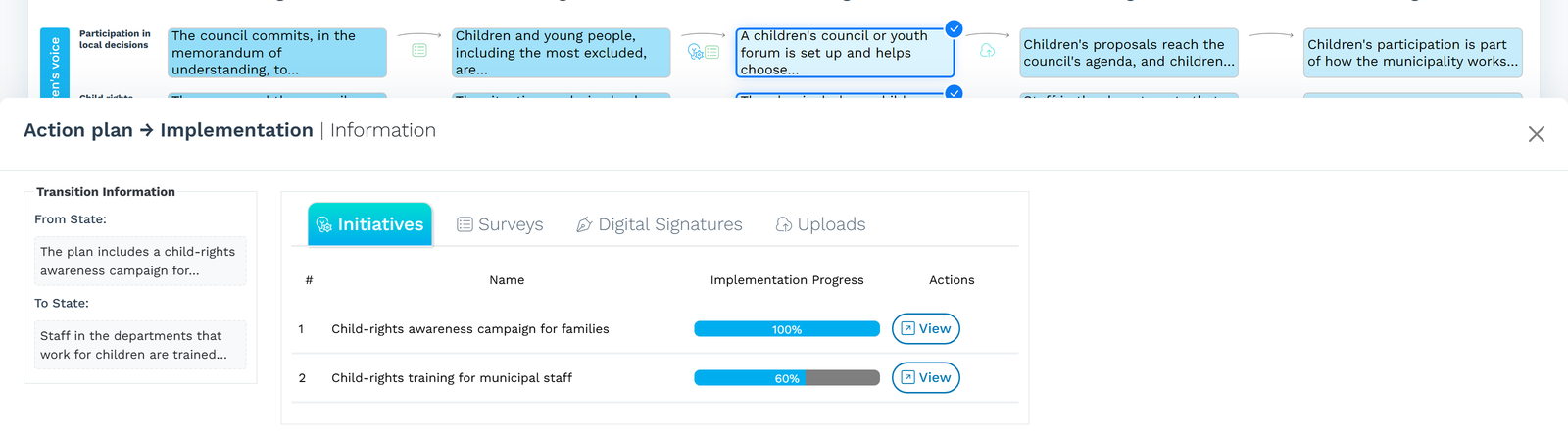
In the second way, nobody decides. Each step between two stages carries work: initiatives with their progress, surveys to answer, documents to sign. When the work of a step is complete, the partner moves to the next stage on that theme. Your team does not chase, the partner does not wait, and nobody argues about a position, because the rule is the same for everyone.
This frees both teams at once, and it gives partners the clearest possible answer to "what do we need to do to move?": this list, finished. It suits programs where the path is concrete: a plan approved, a training held, a policy signed.
The risk is the checklist itself. Automatic progression is exactly as clever as the work you attach to each step. Put "attend a webinar" on the step toward Advanced, and you will soon have a lot of Advanced partners with an excellent attendance record. Keep each step small, attach work that shows real change, and look at the partners who have not moved in months: they may need help, or the step may be badly designed.
3. Set by you: your team decides each position
In the third way, partners send their reports and evidence, and your team reviews them and sets each position. It is the strictest model and, when done well, the most rigorous one: the same people apply the same standard to every partner, so positions are comparable across the program.
It is the right choice when a move has consequences: funding, a certificate, public recognition. A position the partner gave itself convinces nobody outside the room, however honest it was: a medal you pin on yourself rarely impresses anyone. When a stage opens a door, someone other than the partner should decide.
The cost lands on your team. Every review takes hours, partners wait for your decision, and with a small team and a large program you are back in the inbox from the first paragraph. Three habits keep it fair and fast: write down what evidence each stage needs, review on a known calendar (after each quarterly report, say), and let partners ask for a review when they think they have moved.
How the three ways compare
| Self-assessment | Automatic | Set by you | |
|---|---|---|---|
| Who places the partner | The partner | The work done | Your team |
| Your team's effort | Low: review, and a conversation once a year | Lowest: design the steps well, once | High: a review per partner and step |
| The partner's effort | Reflect and decide | Do the work, record it | Send evidence, wait for you |
| What it builds | Ownership and reflection | A clear, shared path | Rigor and comparability |
| Main risk | Too generous, or too modest | Ticking boxes without real change | Your team becomes the bottleneck |
| Works best when | Trust is high and partners are mature | Steps are concrete and checkable | A move unlocks money or recognition |
How to assess partner progress: culture, trust and the program
There is no best way in general, only a best way for a program, a group of partners and a moment. Three things decide it.
Culture. Geert Hofstede's model describes national cultures along six dimensions. One of them, power distance, describes how far the people with less power in organizations accept, and expect, that power is shared unequally [4]. Where it is high, partners may expect the funder to decide, and placing yourself at an advanced stage can feel improper. Where it is low, being placed by the funder can feel paternalistic. But Hofstede himself warns against reading country scores as the values of individuals [4]. A country score tells you nothing certain about the director across the table, so ask before you assume.
Trust. The Trust-Based Philanthropy Project lists simplifying and streamlining paperwork among its six practices, because "nonprofits spend an inordinate amount of time on funder-driven applications and reports" [5]. Self-assessment and automatic progression are trust in practice: you stop asking partners to prove every move. Setting positions yourself is not distrust, though: with new partners it can be the fair choice, if you explain why and say when you will review it. Trust grows, and the way can change with it.
The program itself. What happens when a partner moves up a stage? How concrete is the work between stages? How many partners does each person on your team follow? And what should partners learn: to reflect on their own development, to follow a defined path, or to meet a standard? The guide below helps you write the answers down.
The choice is not forever. A program can start with the team setting positions and hand them to partners once the stages are well understood. Partner groups that need different ways, say long-standing members and newcomers, can run as separate programs on the same path.
Free guide: choosing your partner progress assessment
The guide fits on two A4 pages. Page 1 sets out the three ways and five questions to choose. Page 2 is the worksheet: score your program on six factors, write the decision down (who checks positions, how often, when you will review the choice), and watch for the signs that it is time to change the way.
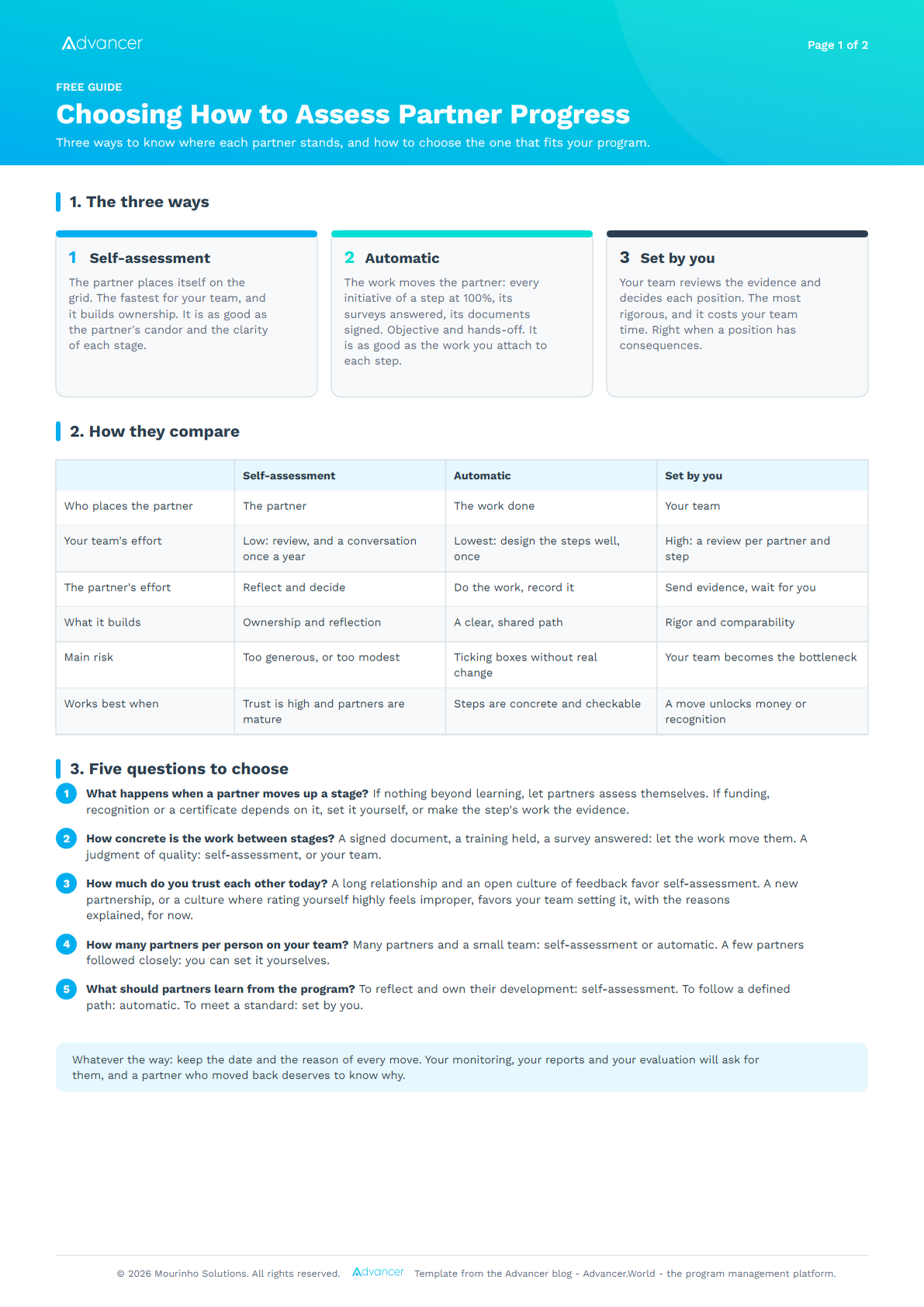
Download the guide to choosing a partner progress assessment (PDF, 2 pages). Fill in page 2 with your team: the discussion is the useful part.
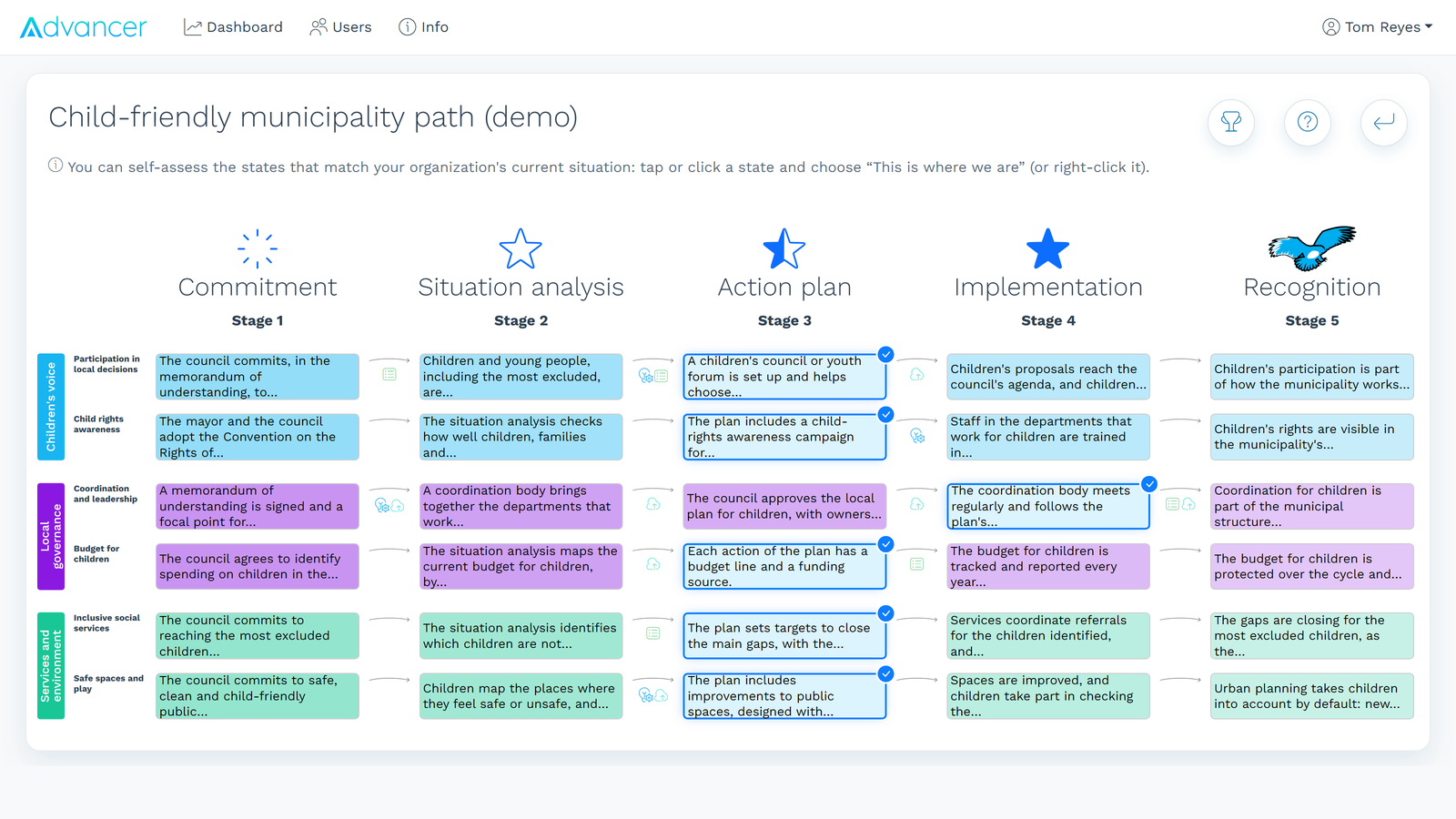
Choose the way, and stop chasing. In Advancer.World each program has its own state progression setting: partners assess themselves, the work they complete moves them, or your team sets each position. Partners see where they stand and what the next stage asks, and you see every partner on one grid. Free to start.
Example: a child-friendly municipality program
The filled-in example is a fictional National Committee running a child-friendly municipality program with eight municipalities: five stages, from Commitment to Recognition, across three themes.
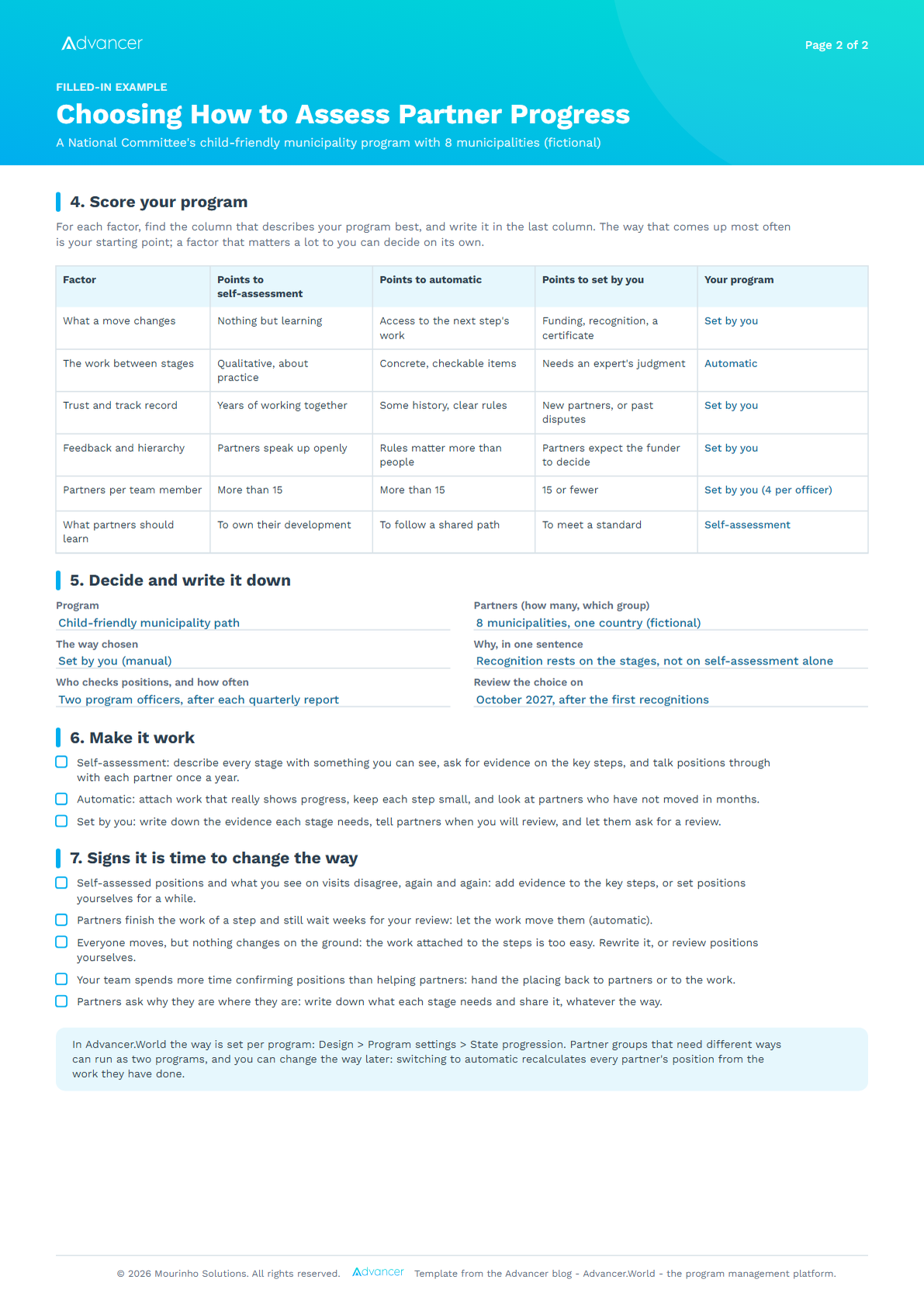
Download the filled-in example (PDF, 2 pages). Three things to notice:
- One factor decides a lot. Recognition depends on the stages, so the team sets positions itself. That factor alone would have been enough.
- Not every factor agrees. The work between stages is concrete (a plan approved, a budget line created), which points to automatic, and the program wants municipalities to own their development, which points to self-assessment. Writing that down is what makes the review date meaningful.
- The choice has a review date. October 2027, after the first recognitions, when the team knows the municipalities and the stages much better.
Setting the way in Advancer.World
Advancer.World was born from the digital transformation of programs at organizations such as UNICEF and Airbus, and the question of how partners move is built into every program. Each program has a setting for it, in Design > Program Settings > State Progression, with three options: Partner self assessment, Automatic after previous transition is completed and We set it manually.
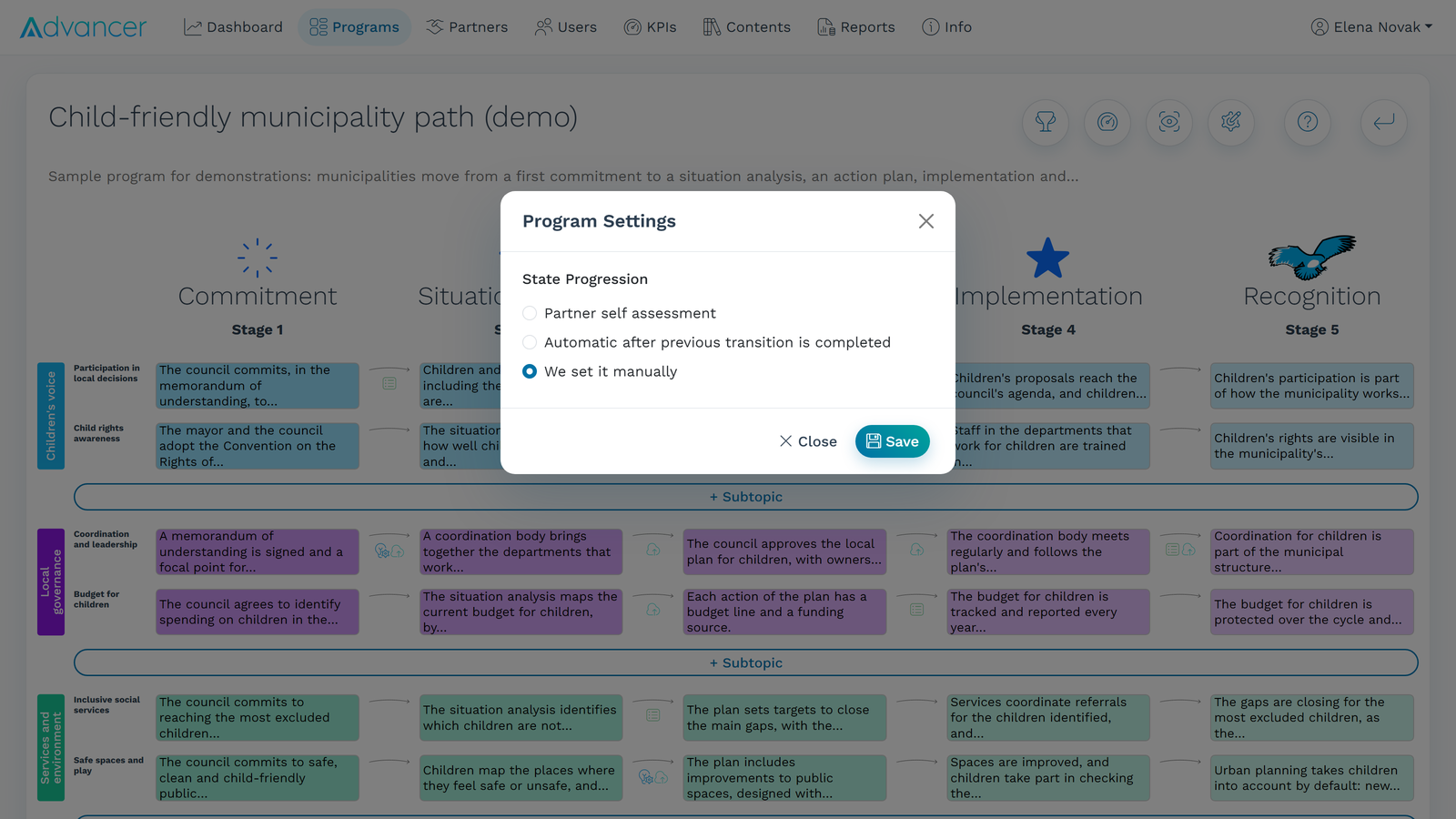
What changes in practice:
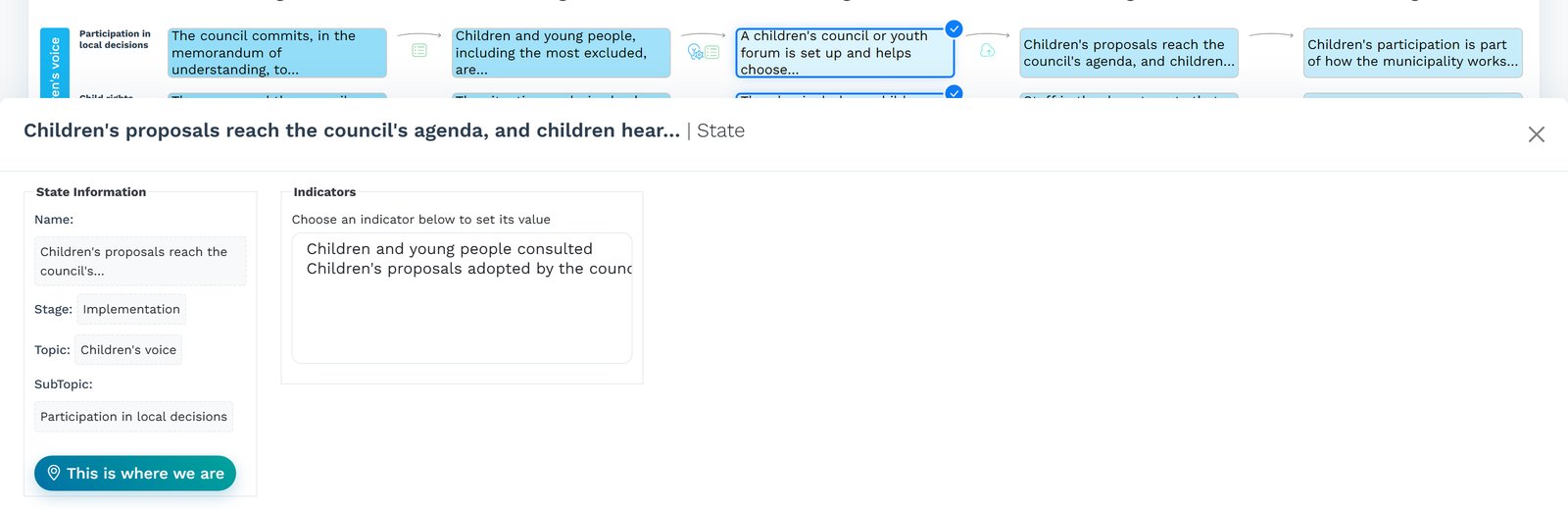
- Self-assessment. Partners open a state on their grid and choose "This is where we are," on a computer or a phone. Your team gets a notification in the app when a partner moves.
- Automatic. A partner moves when every initiative of the step is at 100%, every survey has its required questions answered and every signature request is signed. Uploaded documents and KPI values are recorded as evidence but do not move the partner by themselves. Switching a running program to automatic recalculates every partner's position from the work already done.
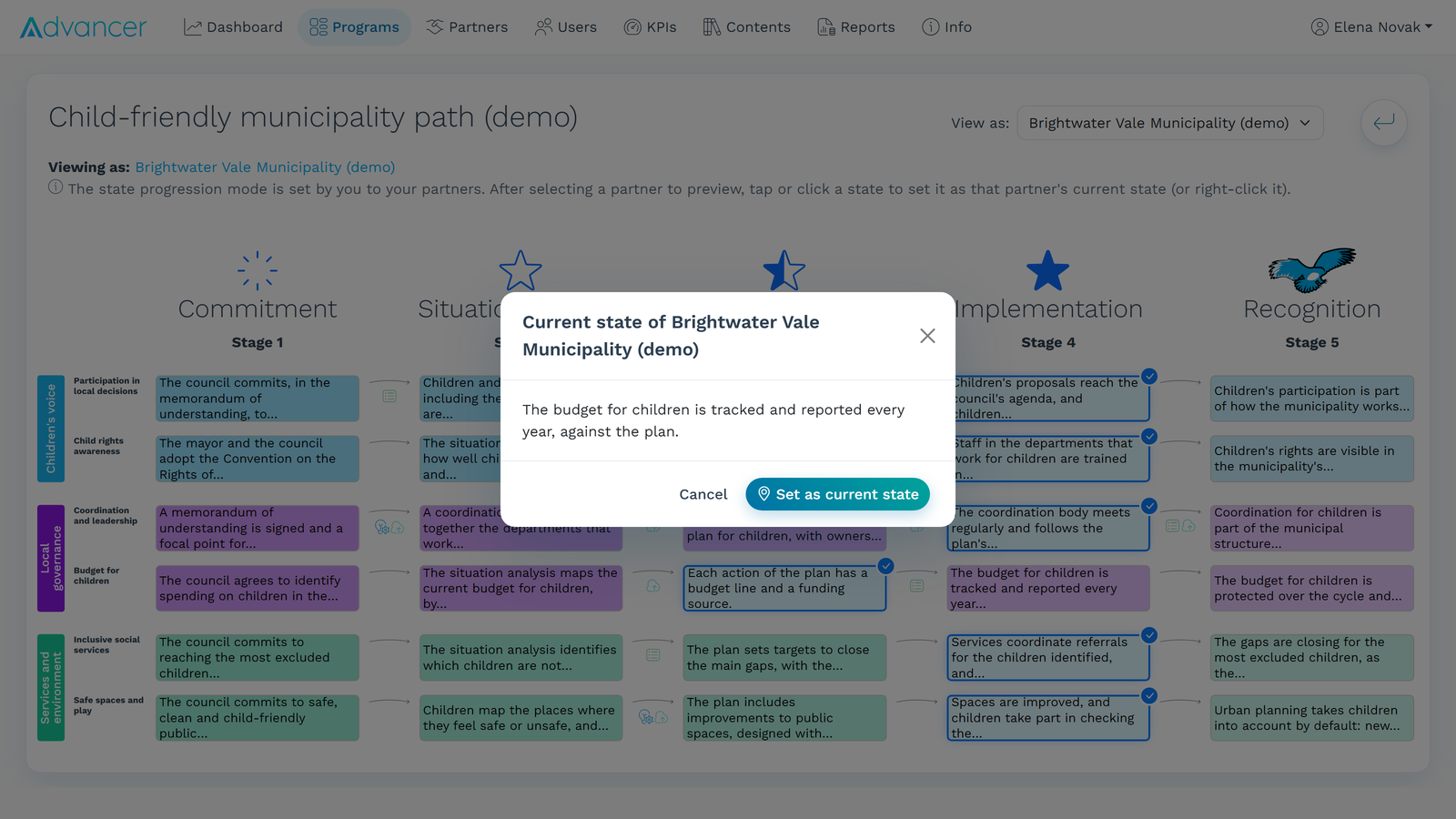
- Set by you. Your team previews the program as a partner, taps a state and chooses "Set as current state." The partner's people are notified, and their grid tells them that the program provider updates their status after reviewing their progress.
Whatever the way, partners see their own position and what the next stage asks, in any of 22 languages, and never another partner's data. Daily snapshots keep the history for your evaluation, and the "How is the program today?" view shows how many partners moved forward or back in the last 30 days and who needs attention. If you are still designing the path, start with how to build a maturity model; for the questions partners answer when they assess themselves, see the organizational self-assessment tool.
FAQ
What is partner progress assessment?
It is how a program knows where each partner stands on its path: the stage reached on each theme, recorded so it can be compared over time. It is the starting point of every report, review and evaluation.
Can we combine self-assessment with our own review?
Yes. Partners place themselves during the year, and your team talks the positions through with each partner once a year, with evidence on the steps that matter most. If positions start to carry funding or recognition, consider setting them yourselves.
Does self-assessment work where hierarchy matters a lot?
It can, if you make it safe: explain why you are asking, describe stages with observable facts rather than praise, and show that a lower position brings support, not penalties. Some partners will still prefer you to decide at first. That is a fine place to start.
How often should partner positions be updated?
With automatic progression, continuously, as the work is done. With self-assessment, whenever a partner's situation changes, with a conversation once a year. When your team sets positions, after each regular report, often quarterly. Positions older than six months tell you little.
Start with the question, not the tool
Before choosing a way, ask what a move up a stage should mean in your program, and who should be able to say that it happened. The answer usually points to one of the three ways. Then spend the days you used to spend chasing on the partners who need you.
Know where every partner stands, without the e-mails. Design your program once, invite your partners, choose how they move, and see each position on every theme, with its history. Partners never pay. Free to start.
References
- International Federation of Red Cross and Red Crescent Societies (IFRC), "Project/programme monitoring and evaluation (M&E) guide", Geneva, 2011, https://www.ifrc.org/sites/default/files/2021-09/IFRC-ME-Guide-8-2011.pdf (accessed November 2026).
- R. M. Ryan and E. L. Deci, "Self-Determination Theory and the Facilitation of Intrinsic Motivation, Social Development, and Well-Being", American Psychologist 55(1), 68-78, 2000, https://selfdeterminationtheory.org/SDT/documents/2000_RyanDeci_SDT.pdf (accessed November 2026).
- E. Zell and Z. Krizan, "Do People Have Insight Into Their Abilities? A Metasynthesis", Perspectives on Psychological Science 9(2), 111-125, 2014, https://www.psychologicalscience.org/journals/perspectives/1745691613518075/ (accessed November 2026).
- G. Hofstede, "Dimensionalizing Cultures: The Hofstede Model in Context", Online Readings in Psychology and Culture 2(1), 2011, https://scholarworks.gvsu.edu/orpc/vol2/iss1/8/ (accessed November 2026).
- Trust-Based Philanthropy Project, "Practices for trust-based philanthropy", https://www.trustbasedphilanthropy.org/practices (accessed November 2026).
© 2026 Mourinho Solutions. All rights reserved.