The launch went well. The new reporting platform had a webinar, a short video and an email from the director. Six months later, most of the program team is back on the shared spreadsheet, a handful of people log in each month, and someone in a meeting asks whether it is time to buy an AI tool.
If you work on digital transformation in NGOs, you have probably lived some version of that story. I have, from several sides: as director of innovation at SISTRADE, a Porto company making ERP, MES and warehouse software, where I founded the innovation department; in innovation projects with companies such Airbus; and from 2023 to 2025 as chief coordinator of UNICEF's global digital transformation ecosystem, working on the global digital transformation strategy, AI policy and generative AI platforms. This article gathers nine lessons from that work that apply to any NGO, federation or network, and a free two-page readiness check to score your own organization against them.
The views here are my own and do not represent UNICEF. Every fact I cite is public and listed in the references.
Digital transformation in NGOs is also a program question
Digital transformation is not a new system. UNICEF's public description of its own approach covers both what the organization does and how it runs, from programs to the way it supports its teams, and its Digital Transformation Change Strategy was one of the core pillars of the 2022–2025 Strategic Plan [1]. The Strategic Plan for 2026–2029 goes further: innovation and digital transformation are one of the three accelerators UNICEF says it will invest in [2].
Most organizations are not short of tools. In the Charity Digital Skills Report 2026, which surveyed 807 UK charities, 79% were using AI tools in some way, yet only 28% had a strategy in place for digital, down from 44% the year before [3]. Tools are arriving faster than the thinking about what they are for. That gap is what the nine lessons are about.
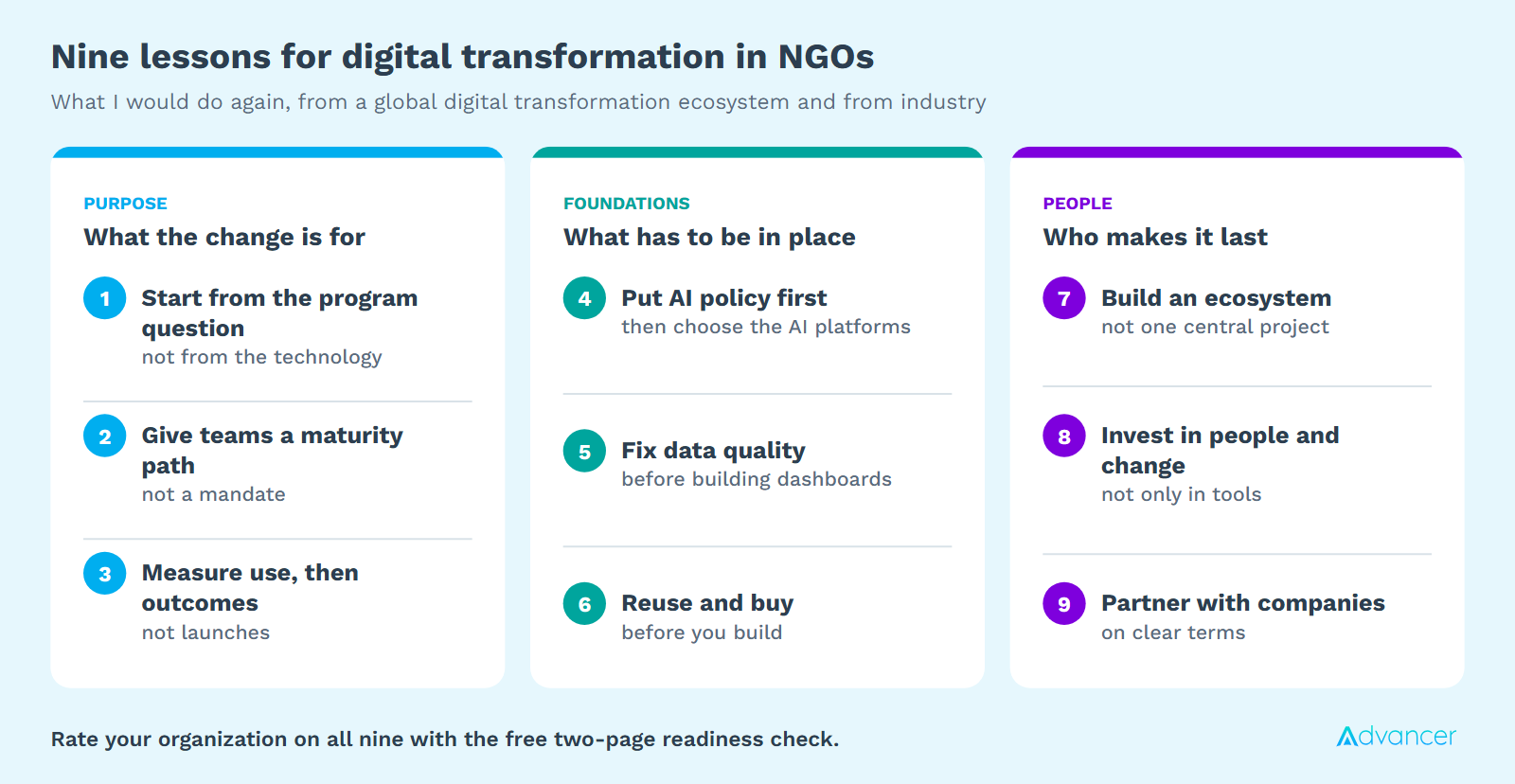
Purpose: what the change is for
1. Start from the supporter question, not the technology
The digital projects I saw stall most often began with a tool looking for a use, or a vague idea based on buzzword. A platform someone saw at a conference, a free license, an impressive AI demo. The ones that lasted began with a question a program team could not answer well enough. Which partners are stuck? Which communities are we not reaching? Why does a donor report take three weeks?
The Principles for Digital Development, endorsed by more than 300 organizations and updated in 2024, turn this into a design rule: the people who will use or be affected by a system should lead or meaningfully take part in designing it [4]. In practice, I would ask every proposal for one sentence: which decision will be better, faster or fairer because of this? If nobody can write it, do not start.
2. Give teams a maturity path, not a mandate
In any organization with many offices, national branches or members, teams start from very different places. One has a data team; the next runs on a shared drive and goodwill. A mandate such as "everyone on the new system by June" produces compliance on paper and workarounds in practice.
What worked better, in my experience, was a path: a short description of what basic, good and advanced practice looks like in each area, so every team can see where it stands and what its next step is, and move at its own pace with support matched to its stage. UNICEF's public page describes digital transformation as "a continuum rather than simply an end goal" [1]. A maturity path makes that continuum visible. It is the same logic as a good partner capacity assessment: you assess with teams, not of them.
3. Measure use, not launches
Launches are easy to count and tell you almost nothing. A platform with a launch date and no regular users is not neutral: it costs licenses, support and goodwill, and it makes the next project harder to sell.
Before launch, agree one or two measures of use: active users per month, records updated, decisions taken with the tool. Look at them every quarter and act on them, which includes retiring what nobody uses. Then go one step further. The Principles for Digital Development note that good practice in monitoring technology now looks at outcomes for people and communities, not just at access and usage [4]. Use is the first sign; outcomes are the point.
Foundations: what has to be in place
4. Put AI policy before AI platforms
Generative AI did not arrive through procurement. It arrived through staff, one browser tab at a time. In the same 2026 survey, 51% of charities had no AI policy, and only 18% had a formal one [3].
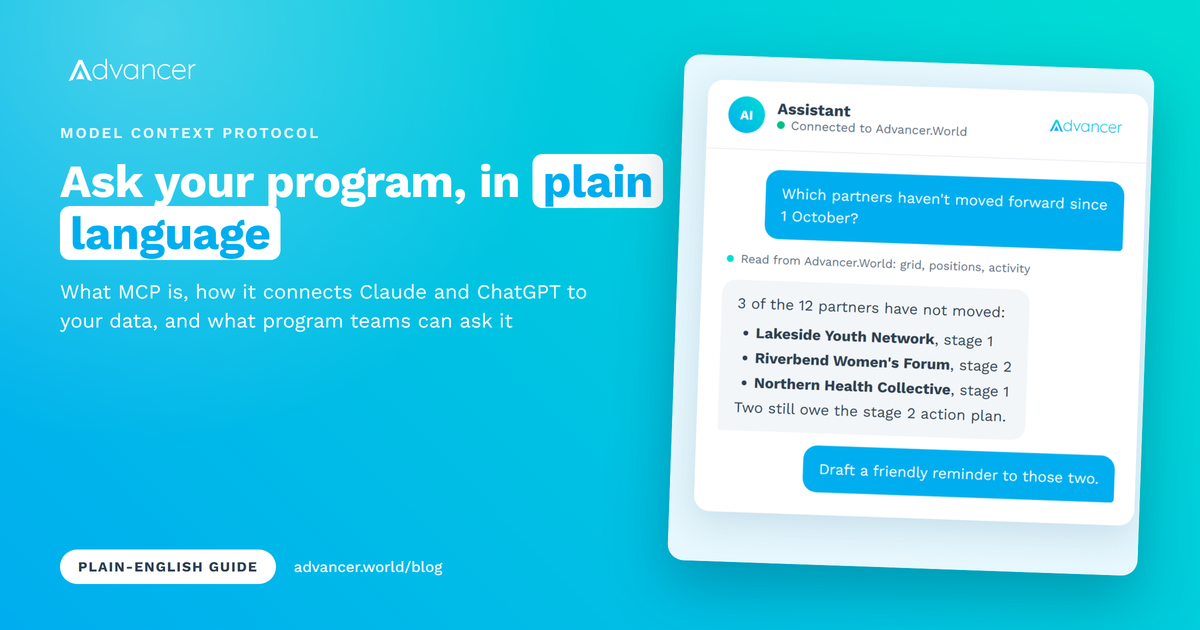
Working on AI policy and generative AI platforms taught me that the order matters. First decide what data may go into which tools, which tools are approved, who is accountable and how a person checks the output. Then choose the platform. For organizations that work with children, UNICEF's Guidance on AI and Children, updated to version 3.0 in December 2025, sets out ten requirements for child-centered AI, from safety and data privacy to transparency and accountability; it is written mainly for governments and businesses, and asks civil society organizations to apply it too [5]. A first policy can fit on two pages. If you plan to connect AI assistants to your program data, the checks in my plain guide to MCP apply.
5. Fix data quality before you build dashboards
My training is in operations research, and I spent years building models, including AI-driven fare optimization for Porto's public transport. The model was rarely the hardest part. The data was.
A dashboard makes bad data look official. Before you build one, take the five numbers you report most often and write down, for each, its definition, its owner and where it comes from. If two offices count "people trained" differently, no chart will fix it. And give the data back: people who enter data and never see it used stop entering it carefully. The Principles call this a people-first data practice, which includes sharing data back with the people it comes from [4].
6. Reuse and buy before you build
I say this as someone who builds software for a living: most of what an NGO needs already exists. Case management, finance, CRM, surveys, document signing. Someone in your network has probably solved your problem already, and would be glad to share.
"Avoid innovation for the sake of innovation" is how the Principles for Digital Development introduce sharing, reusing and improving, and they warn that do-it-alone approaches waste resources, a particular problem with public donor funds [4]. Build only what is truly specific to your mission. When you do, present the long-term cost of ownership up front, as the Principles also ask: licenses, operations, maintenance and capacity building, for years rather than for the length of a project [4].
People: who makes it last
7. Build an ecosystem, not one central project
A central team cannot transform a global organization alone, and it should not try. It can set direction, agree standards and offer shared platforms. The change itself happens in offices and teams.
In my experience, the most useful thing a central team can do is convene: a community of practice where people across offices meet regularly, show what works and adopt each other's solutions. The central team becomes a curator as much as a builder. Celebrate reuse more than novelty, and give local teams time or a small budget to adapt a solution instead of starting from zero. The first of the Principles for Digital Development points the same way: understand the existing ecosystem before you add to it [4].
8. Invest in people and change, not only in tools
Tools are the easy part of the budget. In the 2026 charity survey, 56% named skills and technical expertise as the most significant barrier to progress with AI, and the share reporting colleagues hesitant or resistant to AI rose from 20% to 34% in a year [3].
Creating an innovation department in industry taught me that innovation is a habit of teams, not a box on the org chart. The same holds for digital transformation. For every rollout, budget training and support, not only licenses. Name a champion in each team. And ask leaders to use the tools themselves, in their own meetings: nothing signals a change more clearly.
9. Partner with the private sector, on clear terms
Technology companies offer nonprofits licenses, expertise and platforms, often generously, and many of those partnerships do real good. Working on innovation projects in industry, including with Airbus, taught me that the partnerships that last are the ones with clear terms from the start.
Before you sign, write down four things: what happens to your data and where it is stored, what it costs after the free period, how you leave with your data in a usable format, and whose roadmap you are following. The Principles for Digital Development ask initiatives to plan for the secure transfer or deletion of data when they end [4]. Judge free and discounted offers by the same criteria as paid ones.
Check your readiness: a free template
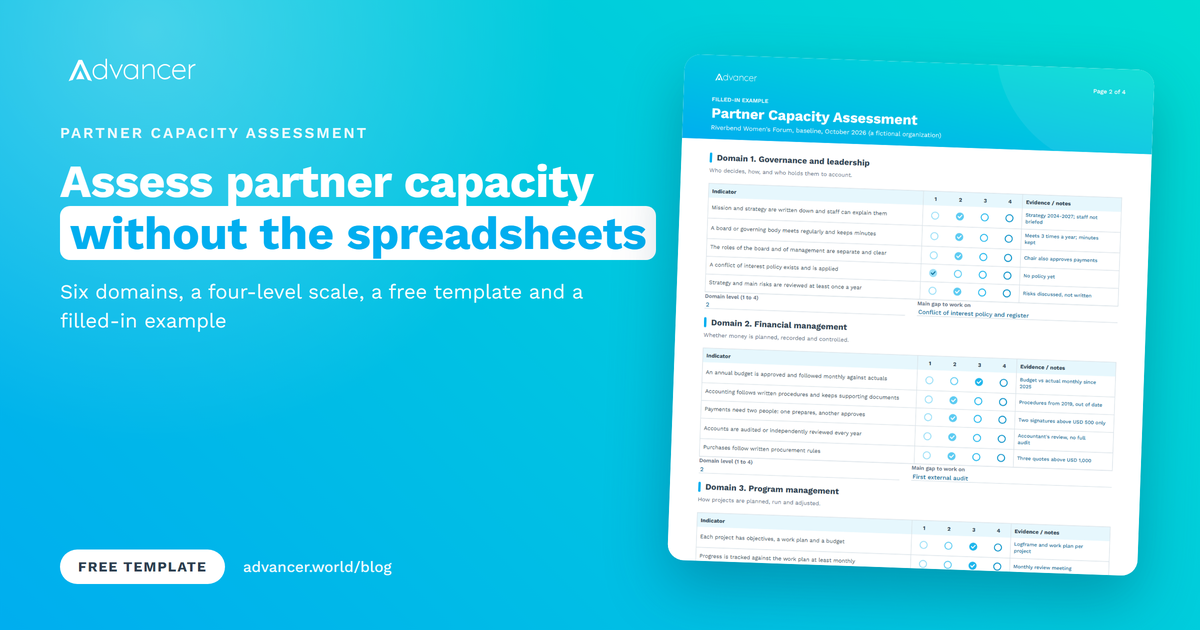
The readiness check turns the nine lessons into 27 statements you rate from 1 (not yet) to 4 (embedded), with a column for your evidence. Add the three ratings of each lesson, look at the profile rather than a grand total, and pick the three lessons where a step forward would matter most for your programs.
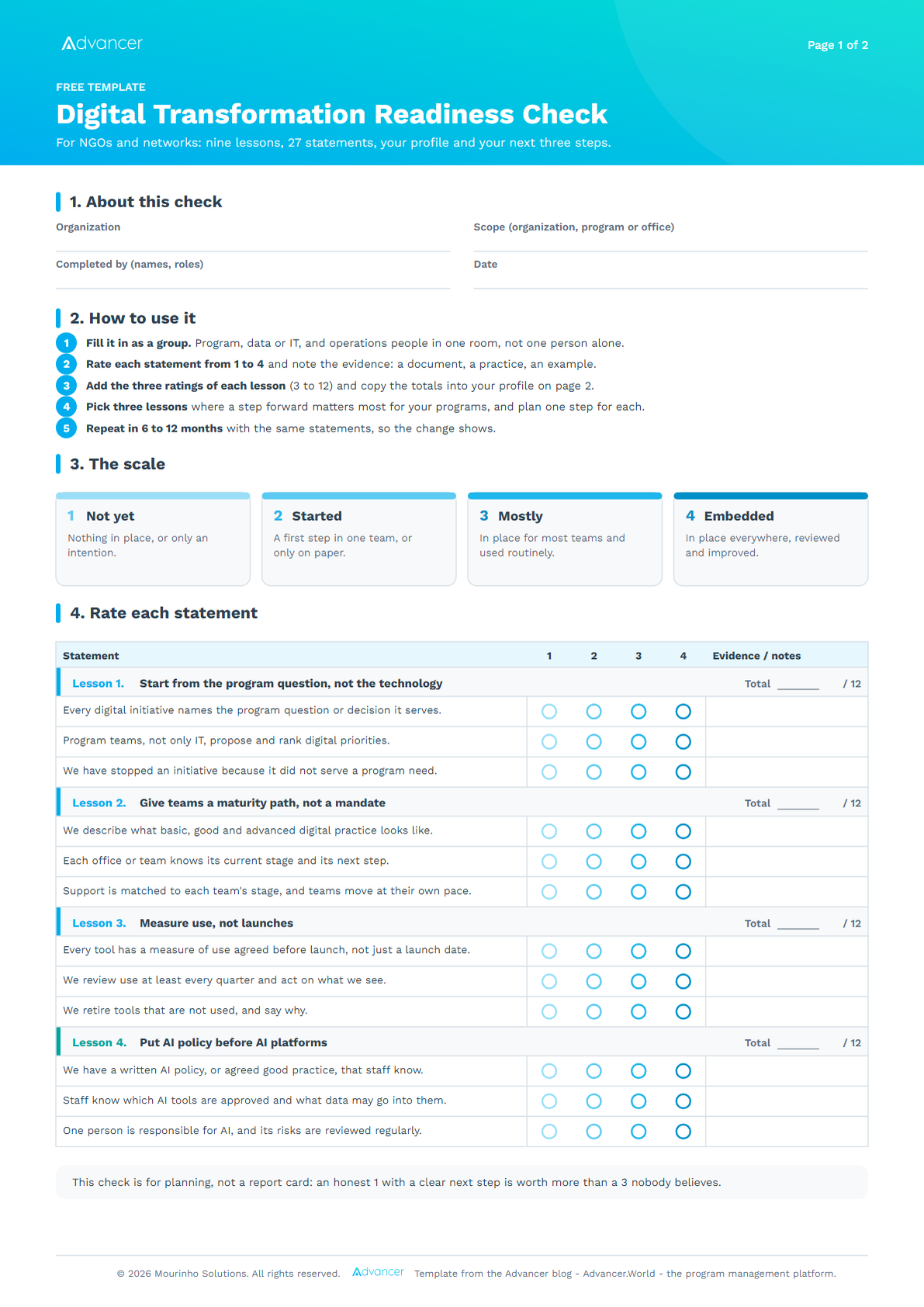
Download the digital transformation readiness check for NGOs (PDF, 2 pages). Fill it in as a group, with program, data and operations people in the room. There is also a filled-in example for a fictional organization (PDF, 2 pages).
Running a maturity path across many offices or members? In Advancer.World you describe the stages once, every office or member organization sees where it stands and what the next stage asks, and you see where each of them stands. Free to start.
From lessons to a tool
Advancer.World, which we build at Mourinho Solutions, is lesson 2 turned into software. It was born from the digital transformation of programs at organizations such as UNICEF and Airbus, and it is open to any organization. A program is a grid: the stages are the maturity levels, the topics and subtopics are the themes, and each cell describes what that level looks like for that theme. The steps between cells carry the work: initiatives, surveys, document uploads and signature requests.
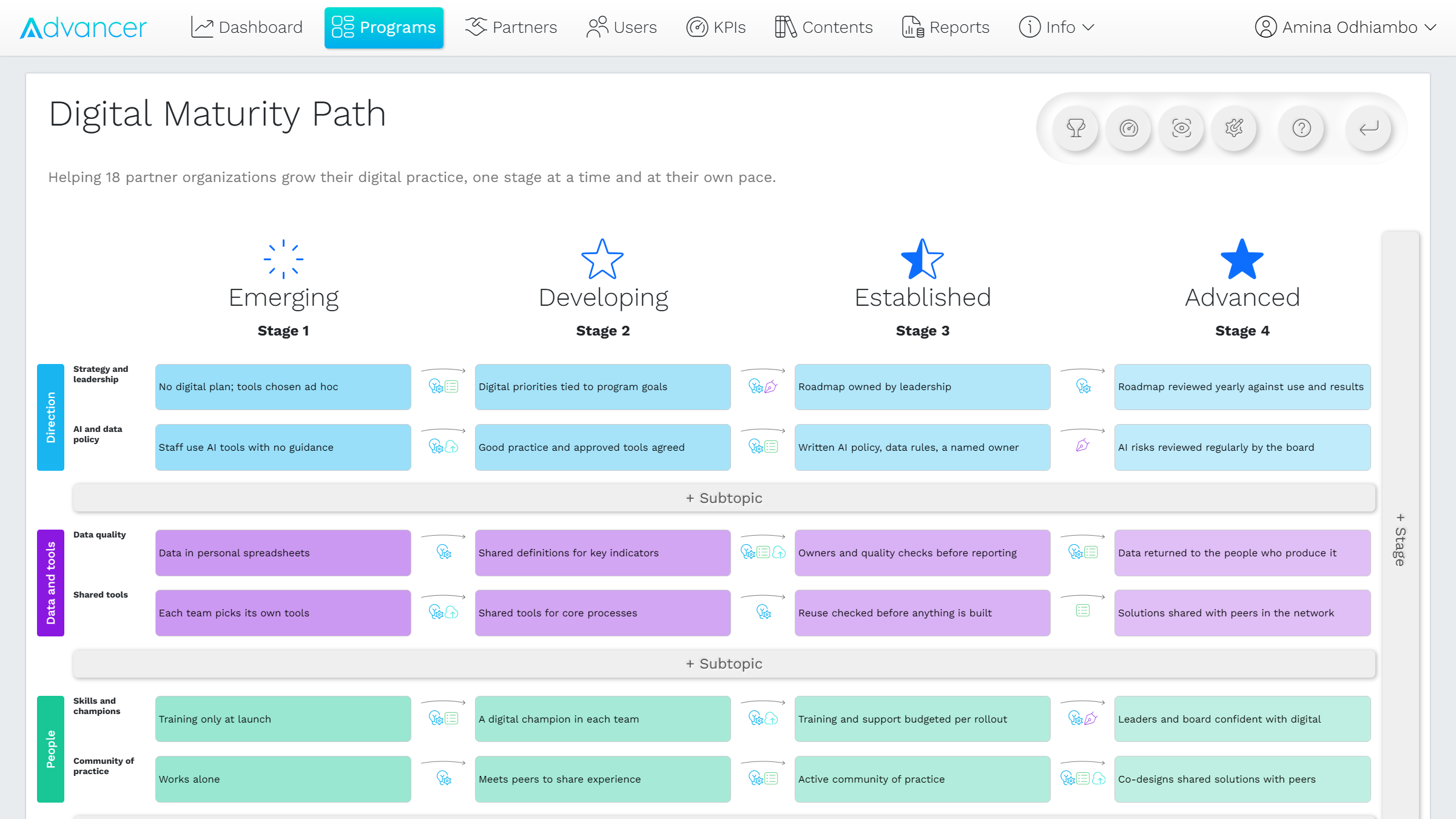
Member organizations or offices are invited by email as partners, and each sees its own position and what the next stage asks, in any of 22 languages. They never see each other's data, and they never pay. You choose how they move: by self-assessment, automatically when the previous step is complete, or when your team confirms it. KPIs and daily snapshots keep the history, so progress shows as a trend rather than a launch date, and AI assistants connect through an MCP server (Gold and Enterprise plans) in which only administrators can change data.
FAQ
What does digital transformation mean for an NGO?
Changing how programs and operations work with digital tools and data, so that decisions become better, faster or fairer. It is an ongoing process rather than a project with an end date: new systems are one part of it, alongside skills, data, policy and ways of working.
How do you build a digital transformation strategy for a nonprofit?
Start from the three to five program questions you most need to answer. Assess where you stand, for example with the readiness check above, pick a few priorities, write a short AI and data policy, agree how you will measure use, and review the strategy every year. Keep it short enough that program staff actually read it. And if you need assistance to kickstart or boost your Digital Transformation Strategy, contact Mourinho Solutions (the company behind Advancer.World) - we deliver tailor-made consultancy initiatives to support your Digital Transformation efforts.
Where should a small NGO start?
With one question and one shared tool. A two-page AI policy, one clean list of the indicators you report, and a named person who helps colleagues will do more than a new platform.
Should an NGO build its own software?
Rarely. Reuse or buy for common needs, and build only what is specific to your mission, with a budget for maintenance over several years. If you do build, share it with peers.
What I would do again
If I could keep only three of the nine, I would keep these: start from the program question, give teams a path instead of a mandate, and count use instead of launches. None of them needs a budget to begin. All of them need someone to ask the question again, meeting after meeting, until it becomes a habit. If you want a second pair of eyes on your own plans, Mourinho Solutions also offers program consulting.
Turn your maturity path into a program people can follow. Stages, themes, the work between them and every member's position in one place. Free to start.
References
- UNICEF Digital Impact, "Digital transformation: Delivering on digital for children", https://www.unicef.org/digitalimpact/what-we-do/digital-transformation (accessed October 2026).
- UNICEF Executive Board, "UNICEF Strategic Plan, 2026–2029" (E/ICEF/2025/29), 3 July 2025, https://www.unicef.org/executiveboard/documents/unicef-strategic-plan-2026-2029-srs-2025 (accessed October 2026).
- Zoe Amar and Nissa Ramsay, "Charity Digital Skills Report 2026", 2026, https://charitydigitalskills.co.uk/report/the-charity-digital-skills-report-introduction/ (accessed October 2026).
- Digital Impact Alliance, "Principles for Digital Development", updated 2024, https://digitalprinciples.org/wp-content/uploads/2025/09/English-Principles-for-Digital-Development-1.pdf (accessed October 2026).
- UNICEF Innocenti, "Guidance on AI and Children 3.0", December 2025, https://www.unicef.org/innocenti/reports/policy-guidance-ai-children (accessed October 2026).
© 2026 Mourinho Solutions. All rights reserved.