Picture a new partner on the Monday after the agreement is signed. A welcome e-mail arrives with six attachments: the full program toolkit in English, three spreadsheet templates, a policy to countersign and a login. The kickoff call is in five weeks. By week six, someone on the program team has written "slow to engage" next to the partner's name.
The first 30 days decide whether a new partner sees your program as a burden or as a path. This partner onboarding checklist takes them phase by phase, for both sides, as a free two-page template with a filled-in example, and covers the welcome pack, one page of expectations in both directions, the first small win, the language question and the 30-day check-in.
What employee onboarding teaches about partners, and where it stops
Most of what we know about onboarding comes from research on new employees. Talya Bauer's guide for the SHRM Foundation, Onboarding New Employees: Maximizing Success, describes four building blocks, the four Cs: compliance (the basic legal and policy rules), clarification (understanding the job and what is expected), culture (the norms, formal and informal) and connection (the relationships and information networks a newcomer needs) [1].
Almost every organization covers compliance, but according to the guide only about 20 percent work systematically on all four [1]. That matches what I see in partner programs: onboarding is the agreement, the policies to sign and a login. The guide also cites research showing that a new hire's trajectory is set as early as the first two weeks [1].
Adapt it with care. A partner is an organization with its own board, mission and funders, often closer to the communities than your program is. You do not onboard it into your culture; you agree how two organizations will work together.
| The C | For a new employee [1] | For a new partner organization |
|---|---|---|
| Compliance | Legal and policy rules | The agreement and the few non-negotiable rules, such as safeguarding, asked once |
| Clarification | The job and what is expected | Where the partner starts, what the first step asks, and what it can expect from you |
| Culture | The organization's norms | Who decides what, how to disagree, how fast each side answers |
| Connection | Relationships and networks | Named people on both sides, and peers who joined the program earlier |
Bauer also calls onboarding "a two-way street" [1]. With partners it is more than that: the program team has as much to learn about the partner as the partner has about the program.
Three commitments to build on
- The Principles of Partnership, endorsed by the Global Humanitarian Platform in 2007, name five: equality, transparency, a result-oriented approach, responsibility and complementarity [2]. Transparency means early consultation and early sharing of information. Responsibility means committing only to what you can deliver: do not promise a monthly call you cannot hold.
- The Core Humanitarian Standard (2024 edition) asks organizations to regularly assess the quality and effectiveness of their relationships with partners and correct course when needed [3].
- The Grand Bargain of 2016 committed donors and aid organizations to harmonise partnership agreements and share partner assessment information, to avoid duplication [4]. Before you send a form, check whether the partner has already answered it for someone else.
The partner onboarding checklist, phase by phase
Every line belongs to the program team, to the partner or to both, and its owner is a person, not a team.
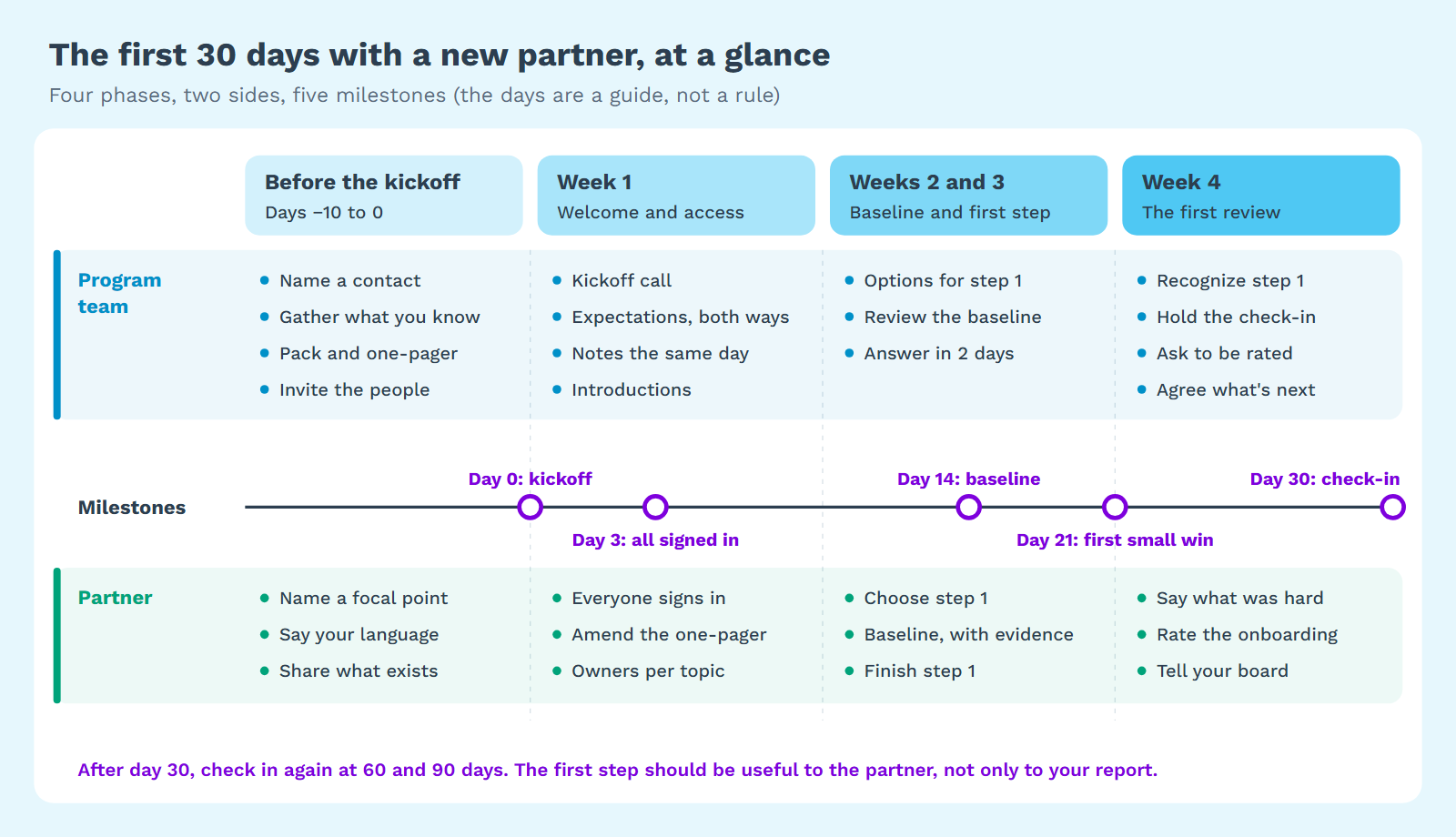
Before the kickoff (days −10 to 0)
The goal: nothing on day 0 is a surprise. The program team names an onboarding contact and a backup, gathers what it already has (due diligence, past assessments) so nothing is asked twice, prepares the welcome pack in the partner's working language and invites at least two of the partner's people. The partner names a focal point and a backup, says which languages it works in and what limits it has (connectivity, devices, busy weeks), and sends the documents it is happy to reuse.
Week 1: welcome and access (days 0 to 7)
A kickoff call of 90 minutes at most: why the program exists, how it works, where this partner starts. Send the notes and the welcome pack the same day. By day 3, every named person should have signed in and found the first step: a login that fails in week 1 quietly becomes "they never engaged" in week 6. Then introduce a peer partner who joined earlier. In my experience, a short call with a peer answers the questions partners never ask the funder.
Weeks 2 and 3: baseline and first step (days 8 to 21)
The partner completes a baseline self-assessment with evidence, with the people who do the work, and you review it together; where your views differ, record both. The method is in our guide to a partner capacity assessment tool, and how to word the questions in the organizational self-assessment tool. Say in writing that the baseline is for planning support, not for funding decisions. Meanwhile, the partner completes its first step.
Week 4: the first review (days 22 to 30)
Recognize the first step, to the partner and, if it agrees, to the network. Hold the 30-day check-in and agree the next steps and the next check-ins. Bauer's guide recommends milestones such as 30, 60, 90 and 120 days [1]; with partners, the same rhythm works for the relationship.
The 30-day partner onboarding checklist template (free download)
The template puts all of this on two A4 pages: 25 lines in four phases, each marked program team, partner or both, with a checkbox, a suggested day, an owner and the date done, plus the welcome pack, the 30-day check-in questions and the sign-off.
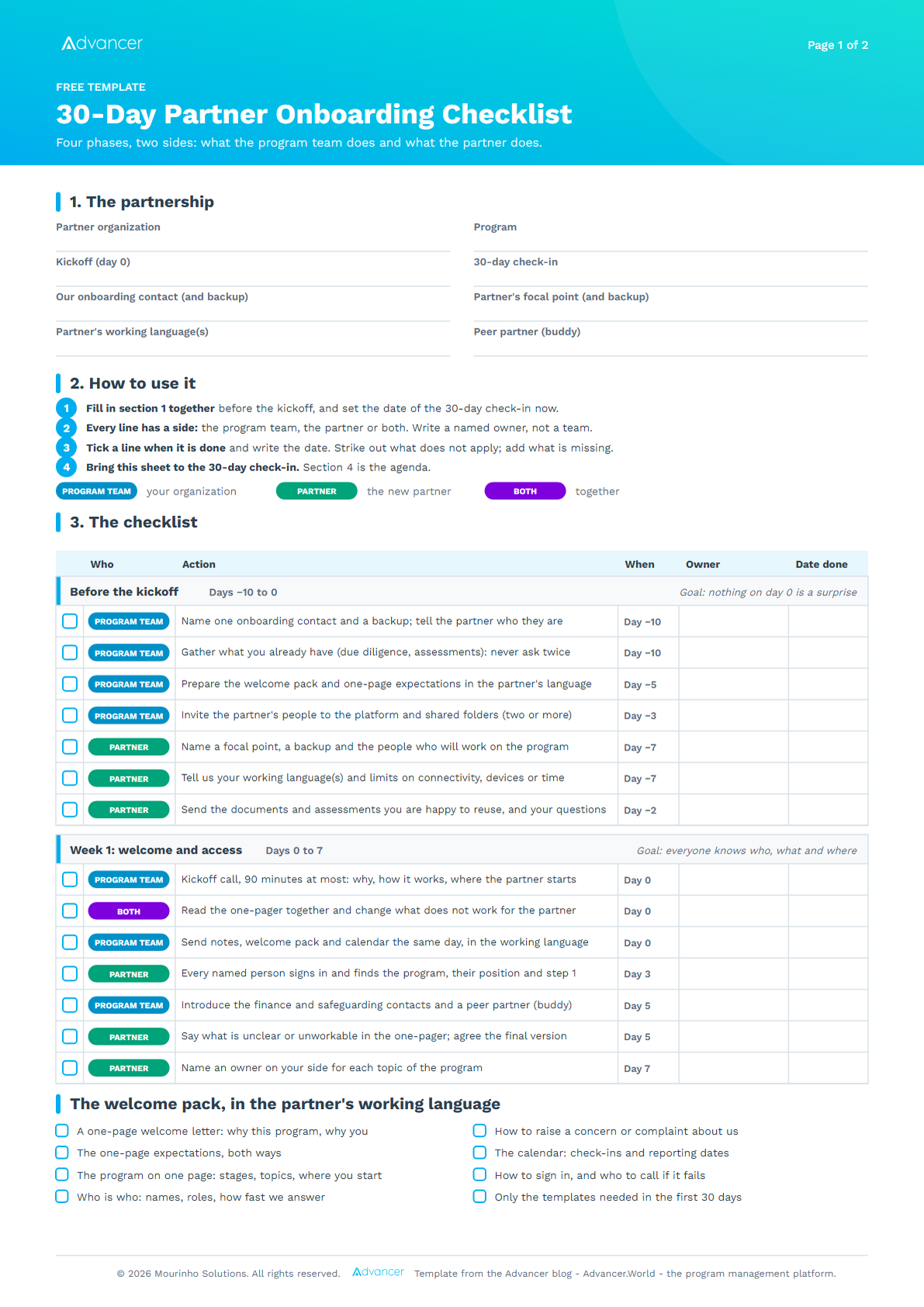
Download the 30-day partner onboarding checklist template (PDF, 2 pages). Print it, or copy the lines into your own partner onboarding process template.
Onboarding several partners at once? In Advancer.World you invite each partner's people by e-mail; they sign in and see where they start on your program and what the first step asks, with its initiatives, questionnaires and document requests in one place. Your team sees where every partner stands instead of asking. Free to start.
Example: a new partner's first 30 days
Here is the checklist filled in for a fictional partnership: Réseau Jeunes Artisans de Thiès, a youth vocational training network in Senegal, joins Horizon Child Fund's Youth Livelihoods Partnership Program, with the kickoff on 5 October 2026.
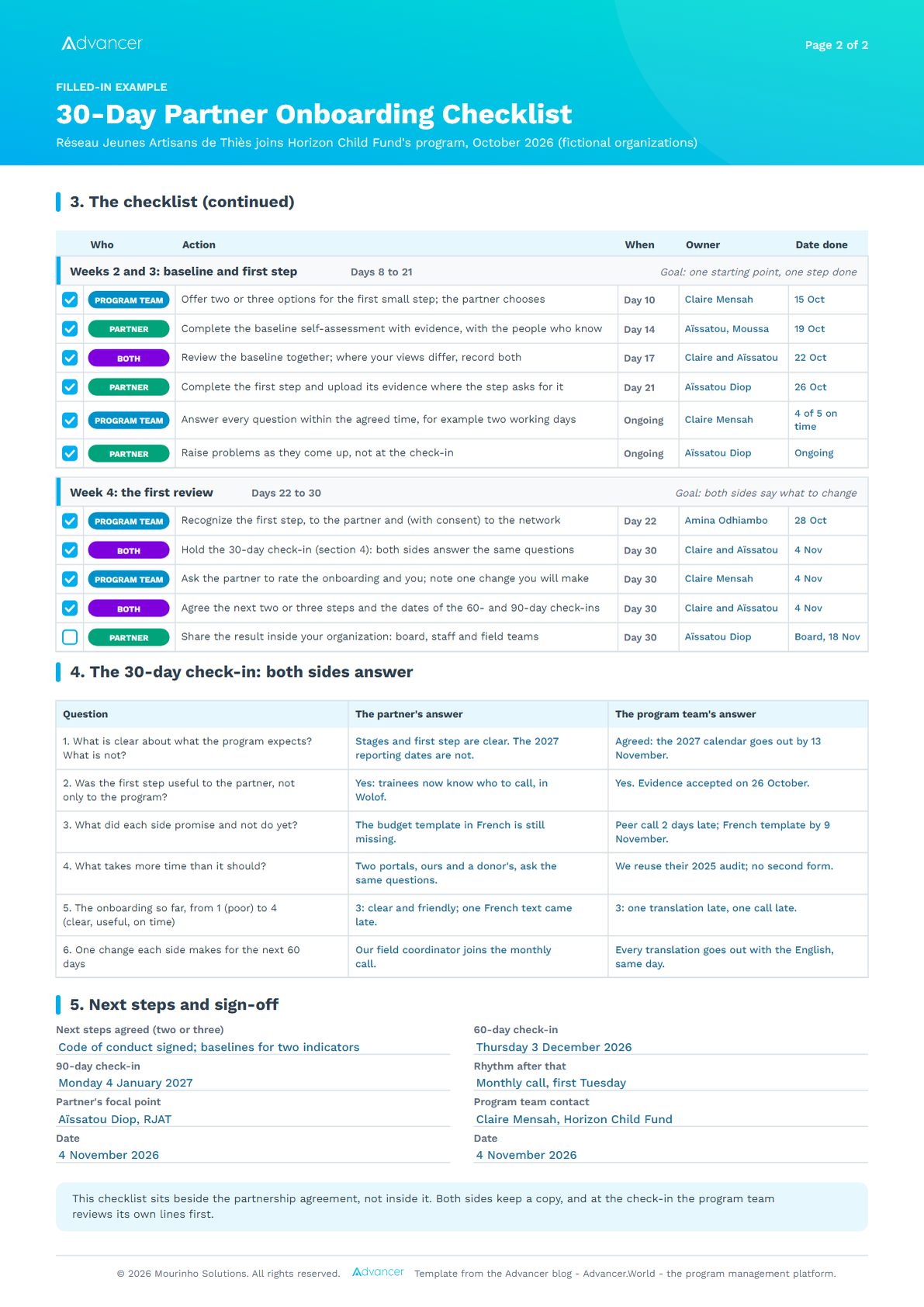
Download the filled-in example (PDF, 2 pages). Note three things: every owner is a person, not a team; one line is honestly not done yet (the partner's board meets after day 30); and the program team rates itself too, admitting one late translation and one late call.
What goes in the welcome pack
The welcome pack has one job: to let the partner start without asking you. In the partner's working language:
- A one-page welcome letter: why this program, and why this partner.
- The one-page expectations, in both directions (next section).
- The program on one page: stages, topics, where the partner starts.
- Who is who: names, roles, how fast they answer.
- How to raise a concern or a complaint about you.
- The calendar: check-ins and reporting dates for the first year.
- How to sign in, and who to call when it fails.
- Only the templates needed in the first 30 days.
Leave out the full toolkit and every policy; they arrive when a step needs them. A thick toolkit on day 0 tells a partner that the program is mostly reading.
One page: what we expect from you, and what you can expect from us
If you write only one document during onboarding, write this one. It turns the Core Humanitarian Standard's "roles and responsibilities of each partner" [3] into a page both sides can check. Write it in pairs: every expectation of the partner has a matching commitment from you.
| What we expect from you | What you can expect from us |
|---|---|
| A named focal point and a backup | A named contact and a backup, and an answer within two working days |
| An honest baseline, with evidence, by day 14 | We use it to plan support, never to decide funding |
| Evidence uploaded where each step asks for it | We ask for each document once, and only what someone will read |
| Tell us early when something is off track | We tell you early when our plans, budgets or dates change |
| Tell us the languages your teams work in | What you need from us, in those languages, at the same time as the English |
| Your honest view at the 30-day check-in | We ask you to rate us too, and say what we will change |
The page sits beside the agreement, not inside it, and the partner should be able to change it in week 1. Equality, in the Principles of Partnership, leaves room for constructive dissent [2]; the one-pager is the first place to use it.
The first small win
The most useful thing you can do in the first month is help the partner finish something. Teresa Amabile and Steven Kramer analyzed nearly 12,000 diary entries from 238 employees in seven companies and found that progress in meaningful work creates the best inner work lives, with clear goals and autonomy among its catalysts [5]. That is research on people, not organizations, but the coordinator who sat through your kickoff needs to tell her director that something got done.
A good first step is:
- Useful to the partner on its own, not only to your report.
- Done in two weeks or less, with the people and money the partner already has.
- Visible: it completes a step of the program, with its evidence.
- Chosen by the partner, from two or three options you offer.
Good examples: tell staff and participants, in their languages, how to report a safeguarding concern; set the baseline for one indicator the partner already counts. Poor ones: a 120-question assessment (not small) or a profile and logo for your annual report (useful to you only). In the example, the partner published its safeguarding reporting channel in French and Wolof, so the young people in training know who to call.
The language question
Ask, do not assume. A working language is often more than one: the board may work in French, the field teams in Wolof. The Principles of Partnership put it plainly: "Language and cultural barriers must be overcome" [2]. Researchers writing in Humanitarian Exchange found that speakers of local languages cannot always get the same information as speakers of international languages, or get it as promptly, which limits their part in time-sensitive discussions; they recommend earmarking resources for translators and interpreters [6]. For onboarding:
- Translate the welcome letter, the one-pager, the stage descriptions and the first templates, and send them with the original, not a week later.
- Offer interpretation at the kickoff and send written notes: people working in a second language often read more easily than they listen.
- Put language support in the budget before the first partner joins.
- Before you mark a quiet partner as disengaged, ask in its language.
The 30-day check-in
Both sides answer the same six questions, and the program team starts with its own answers:
- What is clear about what the program expects, and what is not?
- Was the first step useful to the partner, not only to the program?
- What did each side promise and not do yet?
- What takes more time than it should?
- How was the onboarding, from 1 (poor) to 4 (clear, useful, on time)?
- What one change will each side make for the next 60 days?
Question 4 is where duplication shows up. In the example, the partner was answering the same questions in two portals, and the fix was to reuse its existing audit: the Grand Bargain's commitment, applied to one partnership [4]. Record the answers, including the partner's rating of you, and set the next check-ins before anyone leaves the call.
Onboarding partners in Advancer.World
Advancer.World was born from the digital transformation of programs at organizations such as UNICEF and Airbus. It runs a program as a grid of stages (the maturity levels) by topics. One useful idea for onboarding: call the first stage "Joining". Its cells describe where a new partner starts, and the steps to the next stage carry the first month's work.
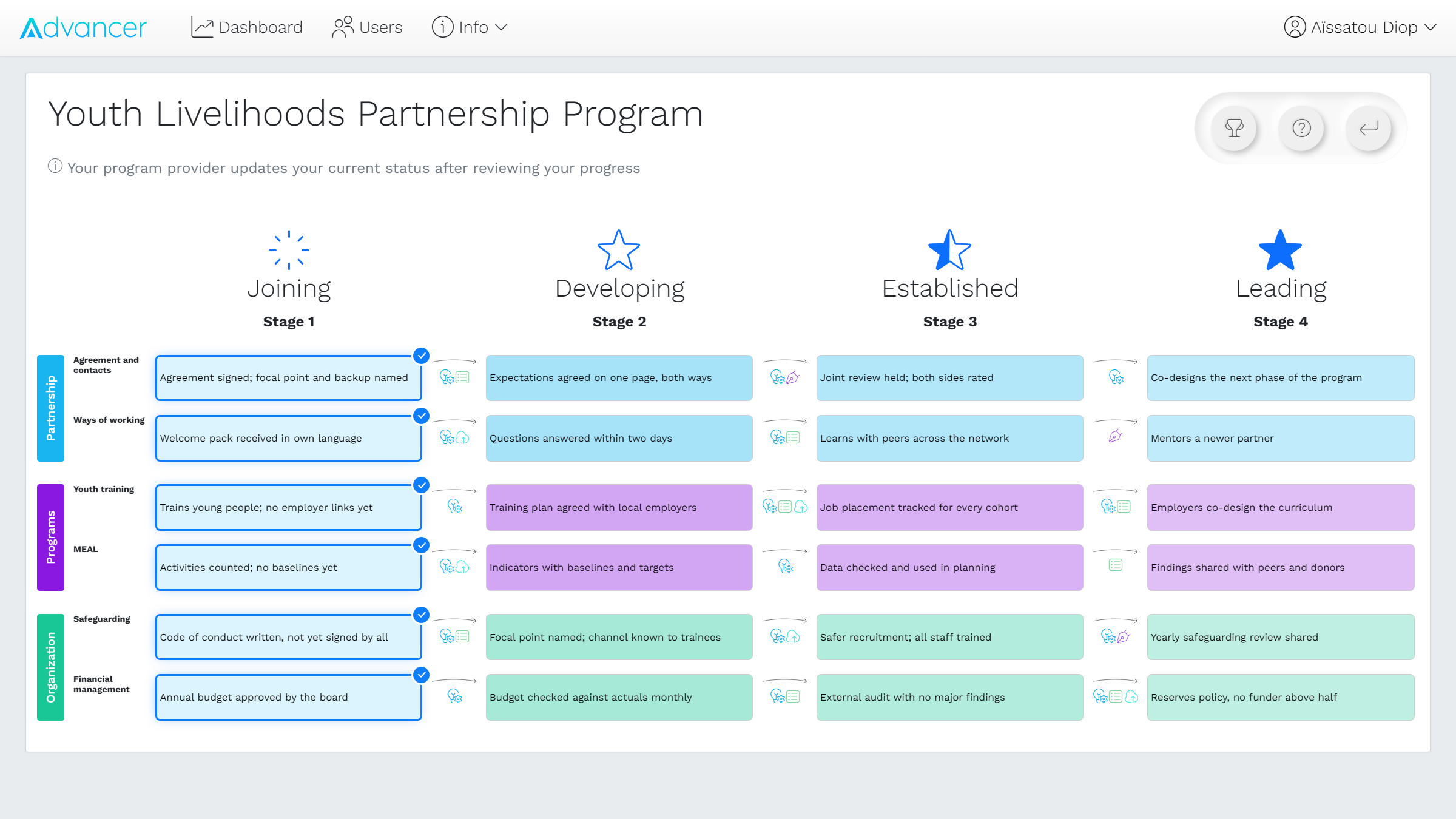
You invite the partner's people by e-mail; they sign in and see their own position and what the next stage asks. The steps carry initiatives, questionnaires (the baseline), document upload requests (the evidence) and e-signature requests (the one-pager, if you want it signed). Partners move by self-assessment, automatically when the previous step is complete, or when your team confirms it. The interface speaks 22 languages, including French, Arabic, Swahili and Hausa. Partners never see each other's data, and they never pay.
FAQ
How long should partner onboarding take?
Thirty days for the first cycle, then check-ins at 60 and 90 days. If the first real milestone is long, such as an audit, choose a smaller first step and keep the day-30 check-in anyway.
Who should own partner onboarding?
One named person on each side, each with a backup; never a shared inbox. Onboarding that depends on one person is one of the first things to break as a program grows, as described in From 10 to 200 partners: what breaks first in a partner program.
Is onboarding the same as due diligence?
No. Due diligence decides whether and how you fund a partner, before the agreement; onboarding starts after it. Keep them apart, and reuse the due diligence documents instead of asking again.
Start with your next partner
You do not need a new system for any of this. Print the checklist, fill in section 1 with your next partner, and put the 30-day check-in in both calendars today. If the partner rates its first month a 3 or a 4, you have a path. If it rates it a 1, you learn it in week 4, not in month 6.
Give every new partner the same clear first month. Design your program once, invite your partners, and let each of them see where it starts and what its first step asks. Free to start.
References
- Talya N. Bauer, SHRM Foundation, "Onboarding New Employees: Maximizing Success", SHRM Foundation's Effective Practice Guidelines Series, 2010, copy hosted by the University of Georgia, https://studentaffairs.uga.edu/wp-content/uploads/2021/08/Onboarding-New-Employees.pdf (accessed October 2026).
- Global Humanitarian Platform, "Principles of Partnership: A Statement of Commitment", 12 July 2007, https://alnap.org/help-library/resources/principles-of-partnership-a-statement-of-commitment/ (accessed October 2026).
- CHS Alliance, Groupe URD and Sphere, "Core Humanitarian Standard on Quality and Accountability", second edition, 2024, https://www.corehumanitarianstandard.org/_files/ugd/e57c40_f8ca250a7bd04282b4f2e4e810daf5fc.pdf (accessed October 2026).
- "The Grand Bargain: A Shared Commitment to Better Serve People in Need", Istanbul, 23 May 2016, https://gblocalisation.ifrc.org/wp-content/uploads/2018/06/grand_bargain_final_22_may_final-2_0.pdf (accessed October 2026).
- Teresa M. Amabile and Steven J. Kramer, "The Progress Principle: Using Small Wins to Ignite Joy, Engagement, and Creativity at Work", Harvard Business Review Press, 2011, https://www.hbs.edu/faculty/Pages/item.aspx?num=40692 (accessed October 2026).
- Mia Marzotto, Kemal Alp Taylan, Fatuma Ibrahim, Marian Ellen Hodgkin, Paul Martin Lukusa Mbwebwa and Charles Abugo, "'How can we contribute if we can't participate?' The accessibility of humanitarian guidance to local and national organisations", Humanitarian Exchange 79, Humanitarian Practice Network, 25 May 2021, https://odihpn.org/en/publication/how-can-we-contribute-if-we-cant-participate-the-accessibility-of-humanitarian-guidance-to-local-and-national-organisations/ (accessed October 2026).
© 2026 Mourinho Solutions. All rights reserved.