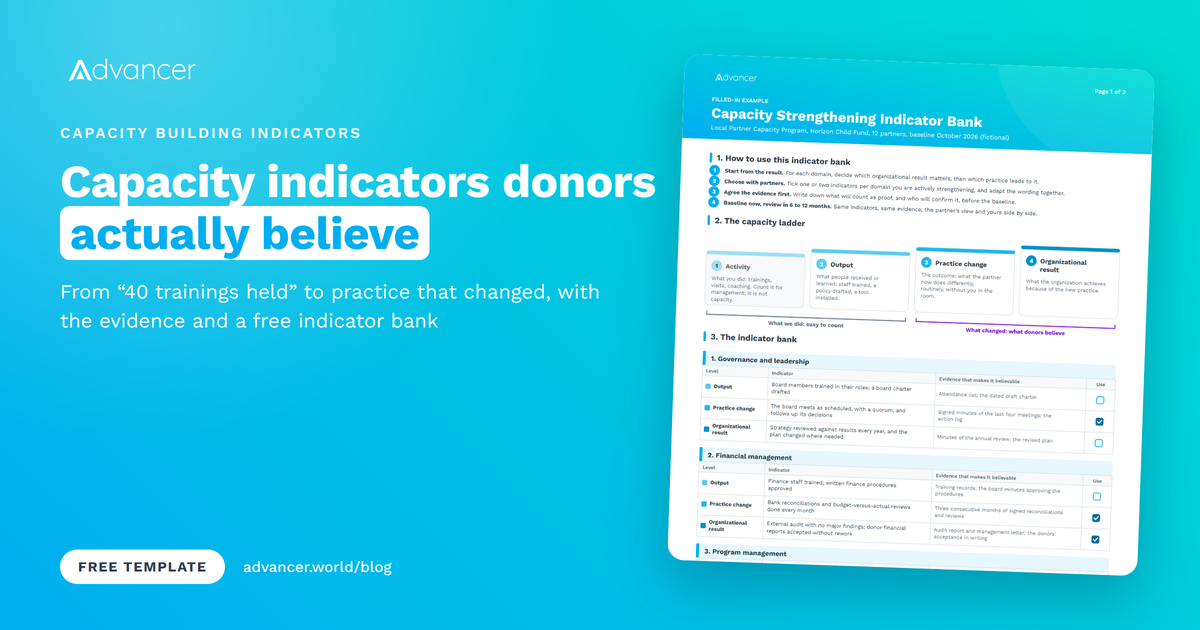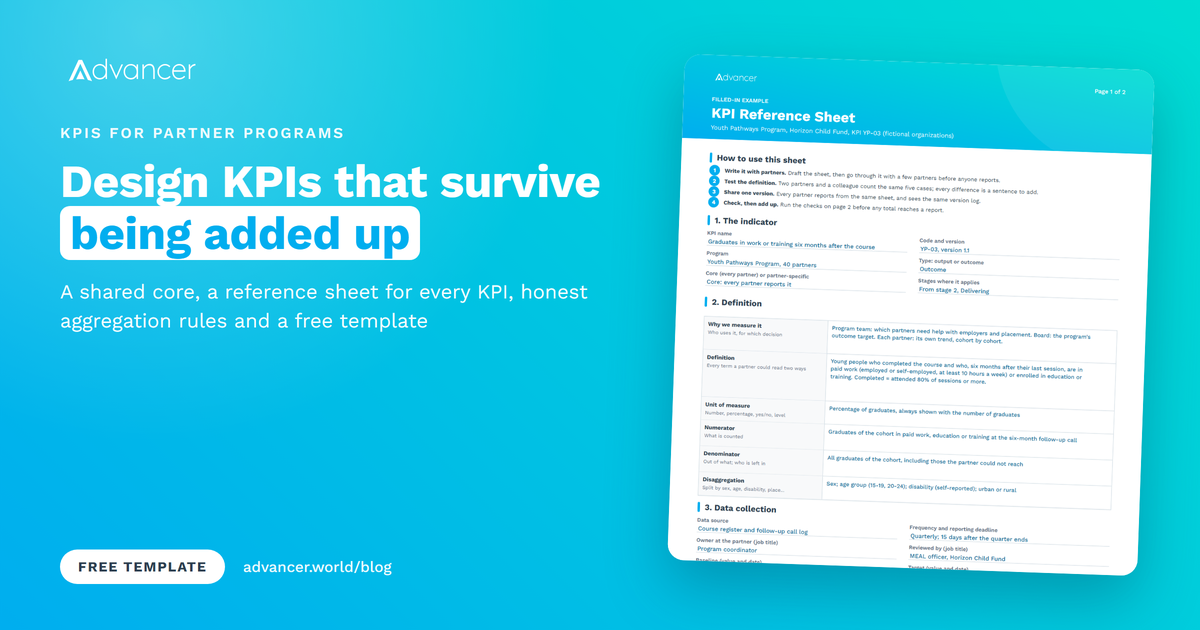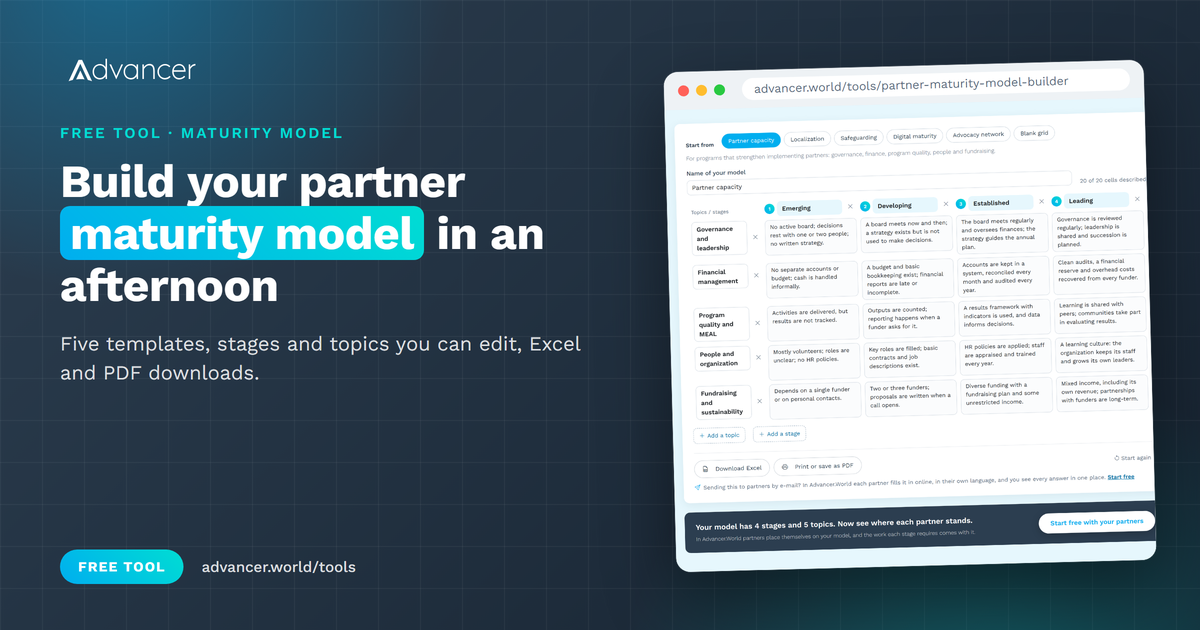
The launch call went well. Thirty national members joined, the secretariat presented the framework, and everyone agreed on the deadline. Three months later, eleven progress reports have arrived in four formats, two members have translated the framework "with small improvements", and the largest member has quietly built a version of its own.
Nobody did anything wrong. This is what federated NGO coordination looks like when the agreements are missing. National members are independent organizations, and a secretariat cannot run them like branches. This guide gives you the agreements a network needs before the work starts: the common core, a decision rights matrix, a shared rhythm, languages, peer learning, data rules and recognition, with a free network program charter and a filled-in example.
Why federated NGO coordination is different
In most federations, the members elect the governing bodies, pay the fees and can leave. The IFRC's framework for developing its National Societies states the principle plainly: their development is "in the first instance, the responsibility of each sovereign National Society" [1]. The secretariat supports; it does not command.
Networks also differ in how much they standardize. Bridgespan's research on nonprofit networks separates federated networks, whose affiliates run mostly standardized program models, from associated networks, which allow more variety [2]. Most federations of national members sit in between, and the line moves from topic to topic. So managing national member organizations is never only a question of what to do. It is a question of who gets to decide it.
The Principles of Partnership, endorsed by the Global Humanitarian Platform in 2007, start from equality: mutual respect whatever the partners' size and power, without ruling out constructive dissent [3]. In a federation where one member has two hundred staff and another has three, that principle is practical, not decorative. In my experience coordinating a global digital transformation ecosystem, the center's real power is convening: setting direction, agreeing standards with the people who will use them and helping members learn from each other. Jane Wei-Skillern and Nora Silver, after a decade of case studies of successful networks, found the same: networks that work rely on trust more than control [4].
Tight on the what, loose on the how
The rule I use is simple to say and hard to keep: be tight on the what and loose on the how. Agree firmly on what progress looks like and how it is measured. Leave each member free to decide how it gets there.
| Area | Tight: common to every member | Loose: each member decides |
|---|---|---|
| The path | Stages and themes, and what each stage looks like | National examples and wording for its audience |
| Indicators | A few core indicators, each defined once | A few national indicators of its own |
| Rhythm | One cycle, with the same dates for everyone | Its own work plan inside each cycle |
| Data | The data-sharing rules | What it publishes about itself, and when |
| Methods | Minimum standards where risk demands them, such as safeguarding | Activities, tools, local partners and the order of the work |
Keep the tight column short. Bridgespan's advice from the networks it studied is a core of three to six program dimensions and three to six organizational ones [2]. The IFRC's Federation-wide Databank and Reporting System, collected every year from its National Societies, rests on eight key performance indicators, defined precisely enough that any National Society following the definitions can submit valid data [5]. Few indicators, defined once, beat many indicators defined thirty ways.
Then let go of the how. The National Academy Foundation, a network of more than 400 high school academies, has a line for it: "When you've seen one local [academy], you've seen one local" [2]. The IFRC framework says the same about support between members: a model should be adapted and imported with care, not exported from one National Society to another [1].
Decision rights: who decides what
Most arguments in a network program are not about the content. They are about who had the right to decide it. Write the answer down before the first argument, in three columns: what the secretariat decides, what is decided together and what each member decides.
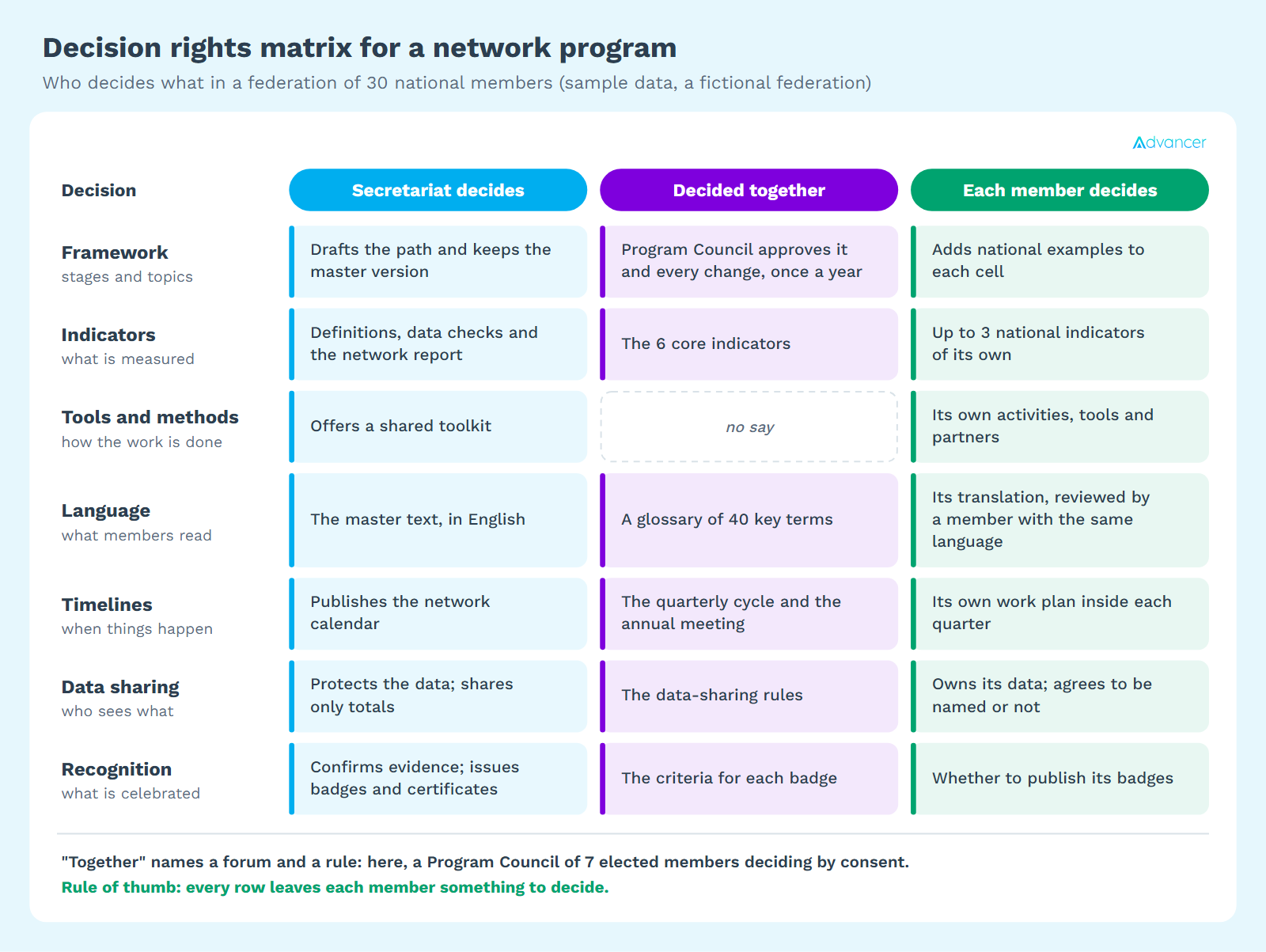
Three rules make the matrix work:
- "Together" needs a forum and a rule. Name the body, such as a program council of seven elected members, and how it decides: consensus, consent or a vote. "Everyone is consulted on everything" is not a decision right. It is a delay.
- Every row leaves members something to decide. If the member column is nearly empty, you are running a centralized program with extra steps, and members will treat it as one.
- Rules that bind every member come from the members. In the IFRC, National Societies discuss and approve, alongside their peers, the policies that set how they and their sister societies act [1]. When Big Brothers Big Sisters made a common set of outcome measures a condition of staying in the network, the agencies voted for it themselves, in 2011, with a two-year phase-in [2].
The network program charter (free template)
The charter puts these agreements on two A4 pages, from the common core and the decision rights matrix to the rhythm, languages, data rules, peer learning and recognition. Fill it in with five or six members in the room, then take it to the whole network.
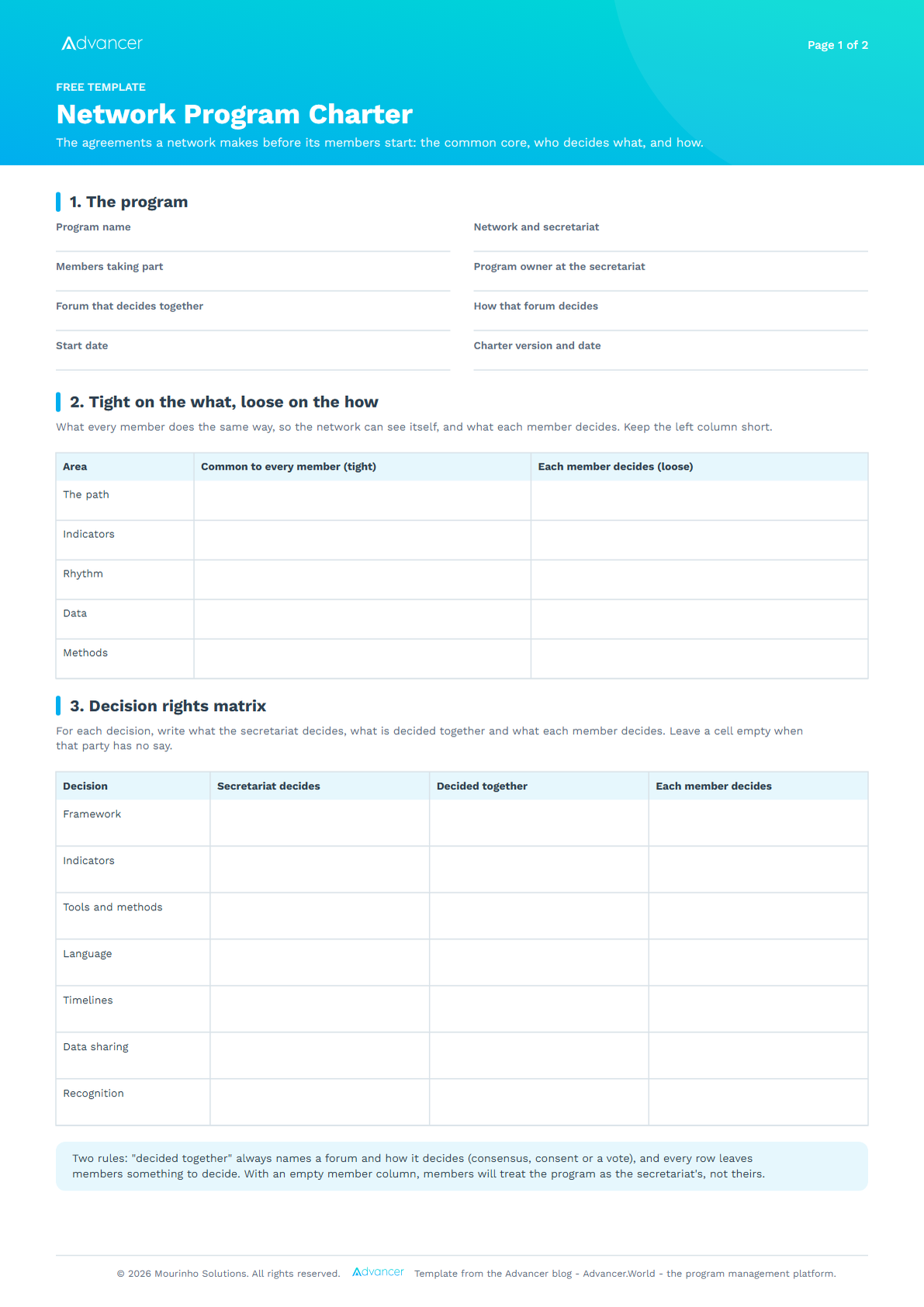
Download the network program charter template (PDF, 2 pages). There is also a filled-in example for a fictional federation of 30 national members (PDF, 2 pages).
Running one program across many national members? In Advancer.World the secretariat designs the path once, every member signs in to see its own position and next step, and you see where all of them stand without collecting reports. Members never see each other's data, and they never pay. Free to start.
A shared rhythm: one cycle for thirty members
Thirty members on thirty calendars produce a network nobody can see. One cycle, the same for everyone, is the cheapest coordination tool there is. This is the example's quarterly cycle:
- Month 1: each member works on its next step, in its own way.
- Month 2: peer circles of four to six members meet, hosted in turn.
- Month 3: each member's focal point updates its position, evidence and core indicators.
- Two weeks after the quarter: the secretariat shares the network picture with every member.
- Once a year: the members' meeting reviews the framework, decides changes and celebrates progress.
The IFRC's databank runs the same mechanics once a year, at a much larger scale: an official e-mail from the Secretary General launches the data collection in the first quarter, a named focal point in each National Society submits the data and key documents, and the data is checked and validated [5]. Two details matter more than the calendar: a focal point in every member, so the secretariat knows whom to ask, and a picture that comes back to members within weeks, the reason they update the next one. A fixed cycle also removes the first thing that breaks as a program grows, chasing status by e-mail.
One framework, many languages
A framework in one language is a framework for the members who speak it. The Principles of Partnership name this under complementarity: "Language and cultural barriers must be overcome" [3]. Four habits help:
- One master version, with a version number. Translations follow it; they never fork it.
- A glossary first. Agree the names of stages, themes and indicators in every language before the rest. Most misunderstandings live in those few words.
- Peer review. Ask a second member who speaks the language to check each translation. The secretariat rarely can.
- Translate the templates too, and on time. If forms and evidence requests stay in English, or lag behind a framework change, members work from old copies.
Members start in different places: a path, not a mandate
In any federation, some members have a data team and others a part-time coordinator. One target for everyone by one date gets compliance on paper and workarounds in practice. A path works better: what each stage looks like, theme by theme, so every member sees where it stands and what its next step is. It is the second of my lessons from leading digital transformation.
In Bridgespan's study, the Public Education Network described three stages, emerging, growing and high-capacity, for each of its dimensions, so one member could be high-capacity on data and emerging on governance. The networks' own advice: stages exist to show the next step, not to punish [2]. If you are building the path itself, my guide on how to build a maturity model walks through it step by step.
The spread between members is also the network's largest reserve of improvement. When the National Guard Youth ChalleNGe Program compared its 33 affiliates in 2010, one site graduated 90 percent of its students from the residential phase and another 58 percent. If every site matched the top quartile, 2,700 more young people would graduate each year, a 35 percent gain without a single new site [2].
Peer learning: members teach members
The secretariat is rarely the best teacher in the network. A member that solved a problem last year, in a similar context, is more credible than any guidance note. The IFRC framework notes that peer leaders are particularly effective at holding up a mirror to a National Society's strengths and weaknesses [1].
A shared path makes those peers easy to find. Big Brothers Big Sisters of America used to group its agencies by size; when it started looking at performance instead, it saw that some smaller agencies with strong results could take on a practice leadership role for others [2]. On a grid, the match is visible: the members at stage 3 or 4 in an area host the members at stage 1 or 2. Wei-Skillern and Silver's advice to networks is to "build constellations, not stars" [4]: many members known for something, rather than one celebrated champion.
Keep peer circles small, mix the starting points, rotate the host, and give hosts something back: recognition, a small budget, or both.
Data-sharing rules members can trust
Members share honest data when they know exactly where it goes. The IFRC's databank guide is clear about ownership: each National Society is "the owner and gatekeeper of its own data" and responsible for complying with data protection law, with the secretariat's technical support [5]. The Principles of Partnership add the other half: trust comes from transparency, with early consultation and early sharing of information [3].
| Data about a member | The member | The secretariat | Other members | Public |
|---|---|---|---|---|
| Its position on the path | All | All | Named only with its consent; otherwise in totals | Only what the member publishes |
| Core indicators | All | All | Network totals | Network totals |
| Evidence, documents and review notes | All | All | No | No |
Two more rules belong in writing. Results never decide membership or funding without a separate agreement. And no member is ranked publicly against another: a league table buys you inflated self-assessments in the next round.
Recognition that keeps members moving
Recognition costs little and works, if it rewards progress and not only arrival. The Land Trust Alliance created a national accreditation program to publicly recognize member land trusts that implemented its standards, and its chief executive described the program as a magnet for organizational change [2]. The IFRC treats the certification of National Societies through its capacity assessment process as an incentive for their development [1].
In practice: recognize each step up the path, not only the top stage, and the members that host peer circles; let each member decide whether to publish its badges; and make certificates verifiable, so a member can show them to its board and funders.
Running a network program in Advancer.World
Advancer.World was inspired by the work i did for UNICEF National Committees, a network of national members. A program in it is a grid: stages on one axis, topics and subtopics on the other, and each cell describes what that stage looks like for that topic. Several people at the secretariat can design it together, in real time.
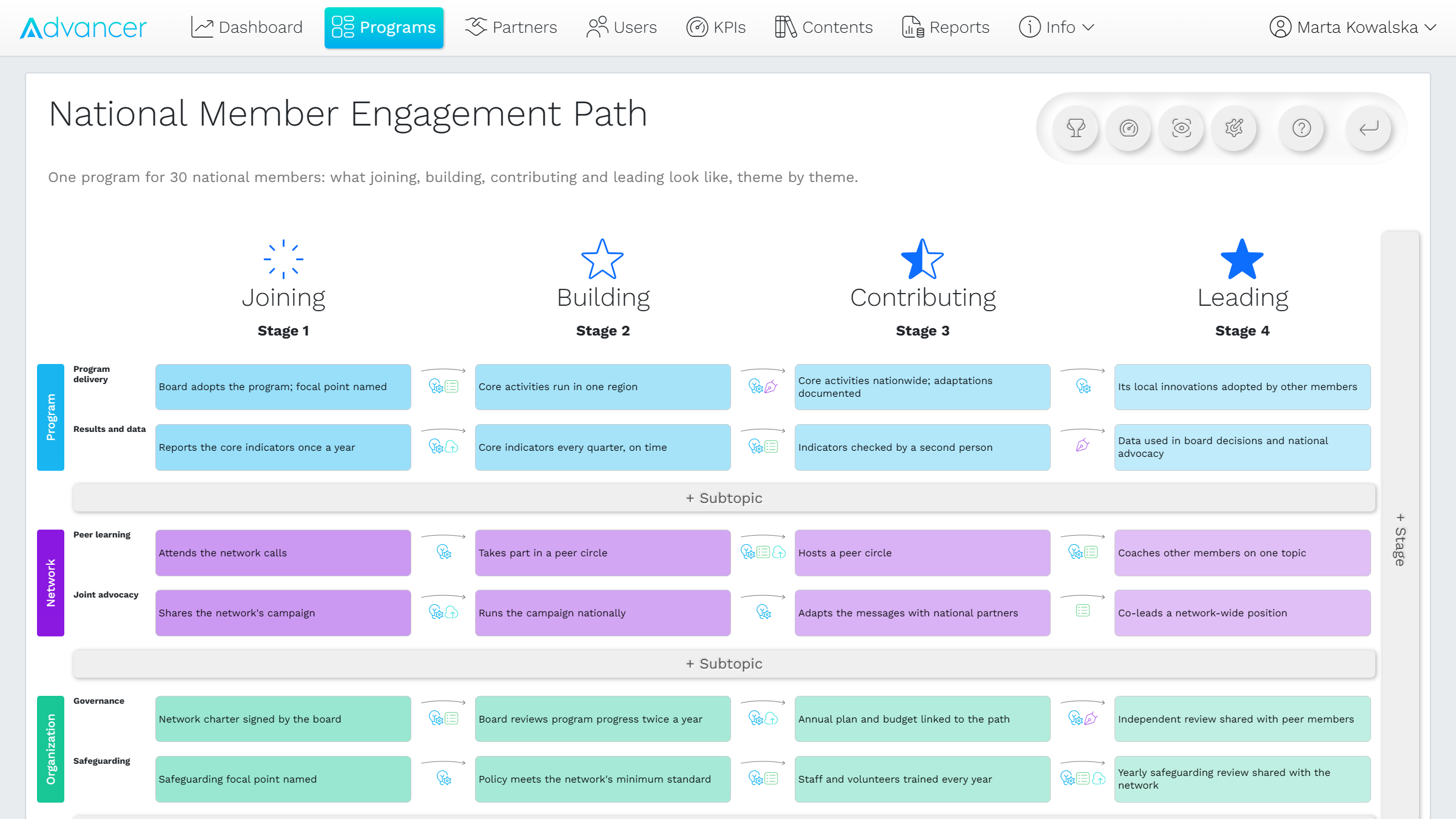
The steps between cells carry the work: initiatives, surveys, document upload requests and e-signature requests. You choose how members move forward: by self-assessment, automatically when the previous step is complete, or when the secretariat confirms it. Members are invited by e-mail and see their own position and what the next stage asks; they never see other members' data, and they never pay. The platform works in 22 languages, including Arabic and Urdu, which read right to left, and the shared toolkit can live in the program's content library.
KPIs are recorded per member, and daily snapshots keep the history, so each quarter's network picture comes from Excel reports or AI-written Word reports with charts rather than from merging files. Badges and PDF certificates with a public verification link take care of recognition. On the Gold and Enterprise plans, the REST API and the MCP server let your own systems or an AI assistant read how members are spread across the stages.
FAQ
How much should the secretariat standardize?
As little as lets the network see itself: the path, a few core indicators, the rhythm and the data rules. If a decision does not change what you can see or compare across members, leave it to the members.
What if a member does not want to join the common program?
Ask why before you insist. Often the framework misses something that matters in that country, and the answer improves it. If taking part becomes a condition of membership, that rule should come from the members' own governing body, with a phase-in, not from the secretariat.
How often should the framework change?
Once a year, in one change window, decided together and announced before the next cycle starts. Changes in the middle of a cycle make results incomparable and tell members the ground can move under them.
Start with the decision rights
If you do one thing before your next network program starts, fill in the decision rights matrix with five or six members. It takes an afternoon, and it saves the year of arguments that otherwise begins with the first report. If you would like a second pair of eyes on the design, Mourinho Solutions also offers program consulting.
One path, thirty members, one picture. Design your network program with your team, invite your national members, and follow every member's progress on the same grid, quarter after quarter. Free to start.
References
- International Federation of Red Cross and Red Crescent Societies, "National Society Development Framework 2013", second printing 2020, https://www.ifrc.org/sites/default/files/2021-07/20200723_NSD_Framework_ONLINE_EN.pdf (accessed October 2026).
- Mandy Taft-Pearman and Alan Tuck, The Bridgespan Group, "Growing Network Impact: How Nonprofit Networks are Raising the Bar on Results", August 2011, https://www.bridgespan.org/getmedia/e50b8f5e-f852-4a27-a275-d99737040fd8/growing-network-impact.pdf (accessed October 2026).
- Global Humanitarian Platform, "Principles of Partnership: A Statement of Commitment", 12 July 2007, https://alnap.org/help-library/resources/principles-of-partnership-a-statement-of-commitment/ (accessed October 2026).
- Jane Wei-Skillern and Nora Silver, "Four Network Principles for Collaboration Success", The Foundation Review, 5(1), 2013, https://doi.org/10.4087/FOUNDATIONREVIEW-D-12-00018.1 (accessed October 2026).
- International Federation of Red Cross and Red Crescent Societies, "Federation-wide Databank & Reporting System (FDRS) User Guide 2024", https://data.ifrc.org/fdrs/assets/documents/FDRS%20User%20Guide%202024_EN.pdf (accessed October 2026).
© 2026 Mourinho Solutions. All rights reserved.